
Strike process
After your GrowStart period, you will move on to the GrowPower period. In this period, we measure your performance against the service standards: 'Items on time', 'Cancellations', and 'Response time'. If you do not meet the standards, you may receive a 'strike'. Are you a well-performing partner and is there only a small deviation? Then you will not receive a strike. Strikes can also expire due to excellent performance. On this page, you can read how it works.
Customers expect a great shopping experience. Together, we make these expectations a reality. We use the strike system to provide insight into your performance and to improve it when necessary.
Are you scoring insufficiently on one of our service standards 'Items on time', 'Cancellations', and 'Response time'? Then you will receive a 'strike'. You can see a strike as a warning. It indicates that you did not meet one of our service standards in a specific week. Of course, this can happen once. But be aware: if you receive too many 'strikes', this can have consequences for your seller account.
No strike and making up for strikes
Mistakes can happen. That's why well-performing partners don't receive a strike if they perform slightly below standard for one week. If you meet the service standards, such as Items on time and Cancellations, over a longer period, you will not receive a strike. Did you still receive a strike? By delivering excellent performance for 2 consecutive definitive weeks, you can have your most recent strike expire sooner.
With a quality score of 75 or higher and a score between 90% and 93% on the 'Delivered on time' service standard, you won't receive a strike for this service standard. For the 'On time handover' service standard, you won't receive a strike if you score between 93% and 95% and have a quality score of 75 or higher.
This means you aren't immediately penalised for a small, temporary dip. This applies as long as your overall performance remains strong. Or discover how to make up for strikes.
The strike system
On the 'Performance' page in your seller account, you can see how many strikes you currently have and check your performance against the relevant service standards.
We keep track of how many strikes you have received in total during the last 22 definitively calculated weeks. See an example below.
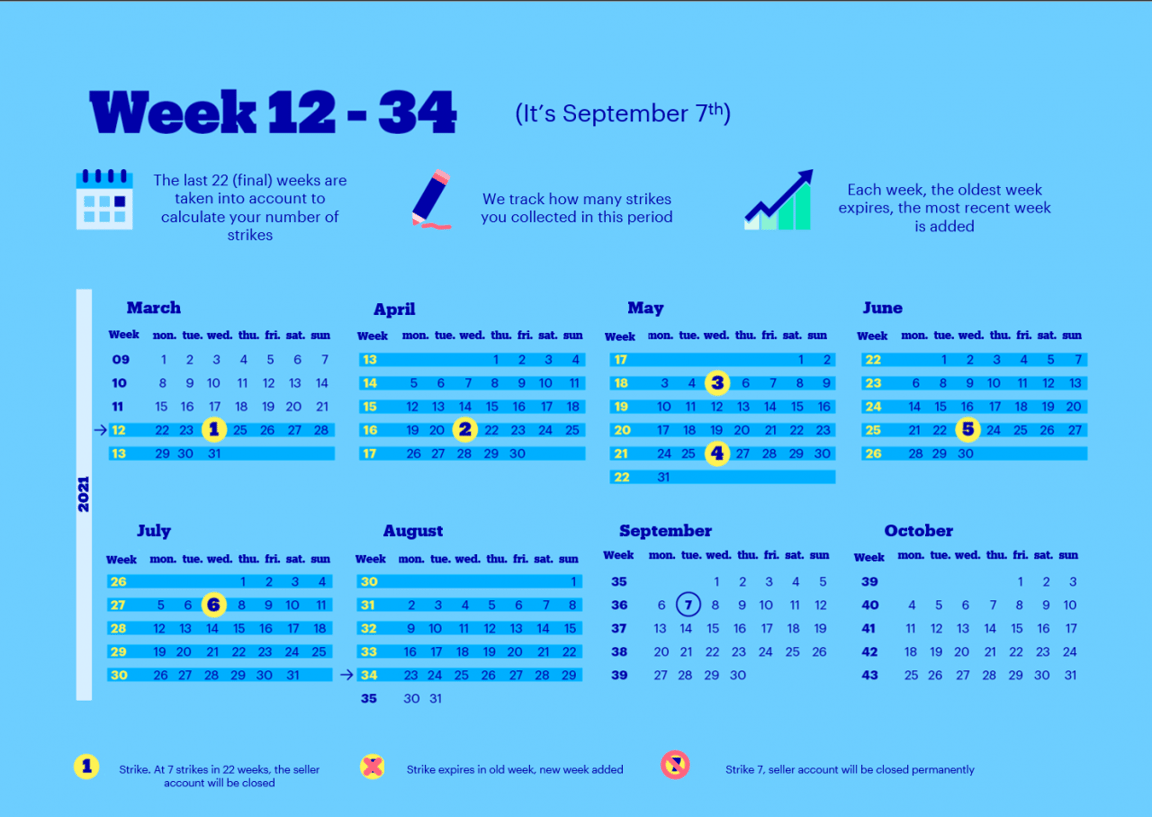
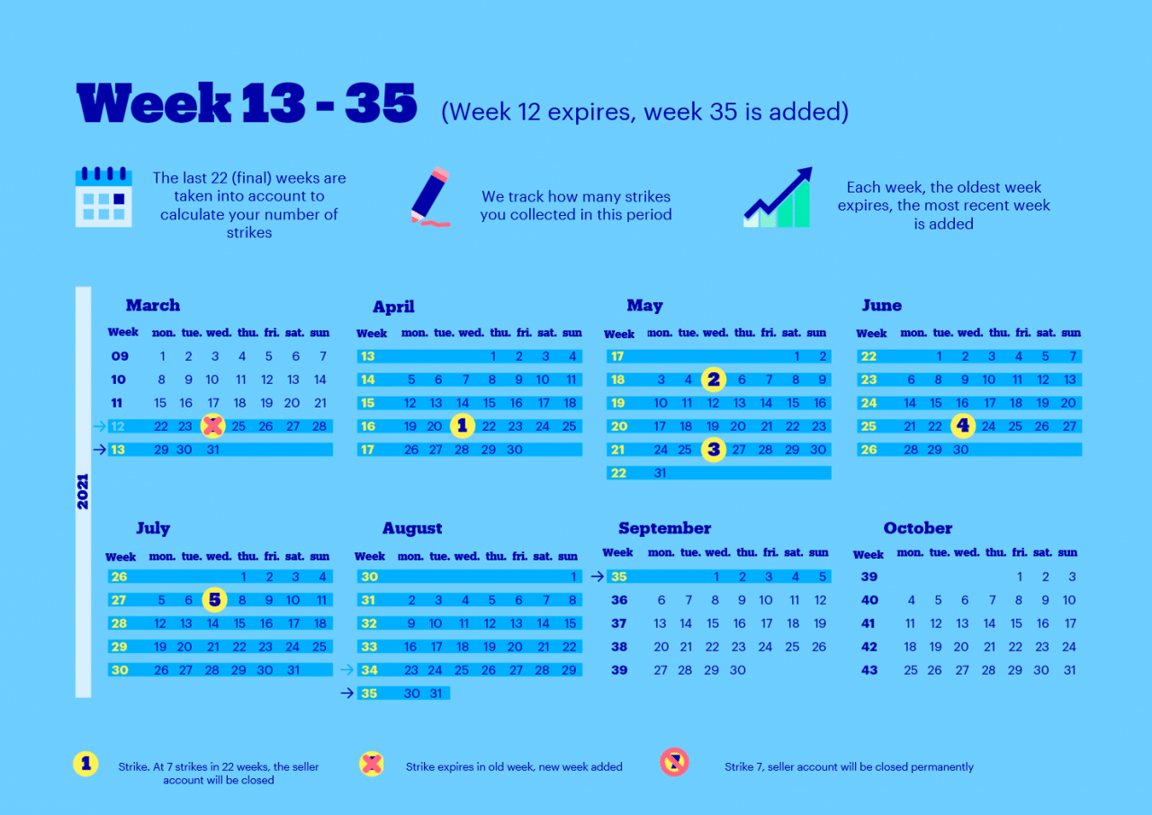
Each week, a new week is added, and the oldest measurement expires. The period over which measurements are taken therefore shifts by one week each time. This means that a strike expires after 22 weeks. In the example below, you can see that when week 35 is definitively calculated, week 12 expires. So, any strike you may have received in week 12 also expires.
The calculation above is similar to the performance score calculation. Here, we look at the last 6 weeks that have been definitively calculated. Below you can see the differences between the strike system and the performance score.
What happens if you don't meet the service standards for a longer period?
- With 1 to 4 strikes, you will receive an email informing you about not meeting the service standards – there are no consequences.
- With 5 strikes, your shop will be temporarily closed, and we will ask you to complete an improvement plan. Please note: if you do not submit the improvement plan within 3 weeks, your shop will be permanently closed. Based on the improvement plan, we will work together to see how you can improve your performance. Is there a chance of success? Then we will reopen your shop, and you can sell via bol again. You will automatically receive an email about this. The improvement plan will be made available on your personal 'Performance' page in your seller account.
- With 6 strikes, you will get a final chance to improve your performance.
- After 7 strikes, your seller account will be closed for at least one year. During that time, you can only view your finances. Your product range will also no longer be visible on the website.
- After 1 year, you can submit an improvement plan. If it is approved, you will regain access to your seller account and can continue selling.
Less chance of strikes
Partners who perform well in the long term will not immediately receive a strike if they perform slightly below standard for one week.
- For the 'Delivered on time' service standard: if you have a quality score of 75 or higher and score between 90% and 93%, you won't receive a strike for this service standard.
- For the 'On time handover' service standard: if you have a quality score of 75 or higher and score between 93% and 95%, you won't receive a strike for this service standard.
Making up for a strike (wipe a strike)
Strikes normally remain valid for 22 weeks. However, if you show excellent performance, strikes can expire sooner. This happens if, for 2 consecutive definitive weeks, you:
- Have sold at least 20 measurable items, of which at least 98.5% were delivered on time
- For the 'Delivered on time' service standard: at least 98.5% is delivered on time
- For the 'On time handover' service standard: 100% is handed over on time
- Have a maximum of 0.5% cancellations
- Handle 90% of customer questions within 24 hours
In addition, a strike in a specific week is only eligible to expire sooner if, in that week, you:
- Score at least 80% on the 'Delivered on time' service standard
- Score at least 85% on the 'On time handover' service standard
- Have handled at least 70% of customer questions within 24 hours
- Have a maximum of 10% cancellations
These good performances are rewarded, and therefore your most recent strike will expire if you meet the above conditions. This means you will be tied to a previously incurred strike for a shorter period.
This reward applies to every most recent strike and can therefore be granted multiple times.
A week in which you perform excellently counts a maximum of 1 time. An example: you perform excellently for 3 consecutive weeks, week 9 to 11. Only week 9 and 10 count towards the expiration of a strike. Week 10 is therefore not counted again with week 11 for the expiration of a strike.

Frequently asked questions
About strikes and service standards