
Storage of items with an expiration date
Logistics via bol, in addition to delivering parcels, handles stock storage for partners. Many items are welcome in our fulfilment centers (Bol Fulfilment Centres, BFCs for short), including items with an expiration date. For these items, we use a specific process; on this page, you can read more about the associated guidelines.
Items with an expiration date (THT) require a different processing method in our BFCs than 'normal' items. We need to properly register the expiration date of these items and ensure that customers only receive items that can be used or consumed within a reasonable timeframe. The following guidelines apply to this process:
- We try to process THT items as much as possible in a BFC specifically equipped for this. This may mean that shipments, for example those consisting of items with and without an expiration date, must be delivered separately.
- A THT item must have a visible expiration date on the item's packaging itself. For each delivered pallet, all items with the same item barcode must also have the same expiration date.
- This means that 2 THT items with different barcodes (EANs) may have different expiration dates, but 2 THT items with the same barcode (EANs) may not have different expiration dates.
- See also article 3.2.2 of the delivery conditions for Logistics via bol
- THT items returned by customers cannot be put back into stock due to food safety regulations. With these returns, it is not possible to verify if the item is still suitable for sale. An item (or its packaging) may have been damaged by external factors. In such cases, we can no longer guarantee the expiration date.
Customer consumption period
For every incoming item, the expiration date is registered and recorded in the BFC systems. To determine how long an item can still be sold, we use different periods:
Production Period (GS-1)
This is the period between when food is produced and its expiration date.
Distribution Period (GS-2)
This is the period between when food is shipped to the BFC and its expiration date.
Block Days
This is the number of days before the expiration date that we still want to sell the item, so that the customer has enough time to use it.
For calculating these ‘Block Days’, we use the following formula;
- Distribution period between 75 and 90 days: 45 days
- Distribution period between 90 and 200 days: Distribution period divided by 2
- Distribution period longer than 200 days: 100 days
bol Sales Period
This period is the difference between the distribution period and the Block Days. This is therefore the time the item is in stock, ready for sale.
Last Delivery Day (ULD)
The last day an item can be dispatched from the BFCs.
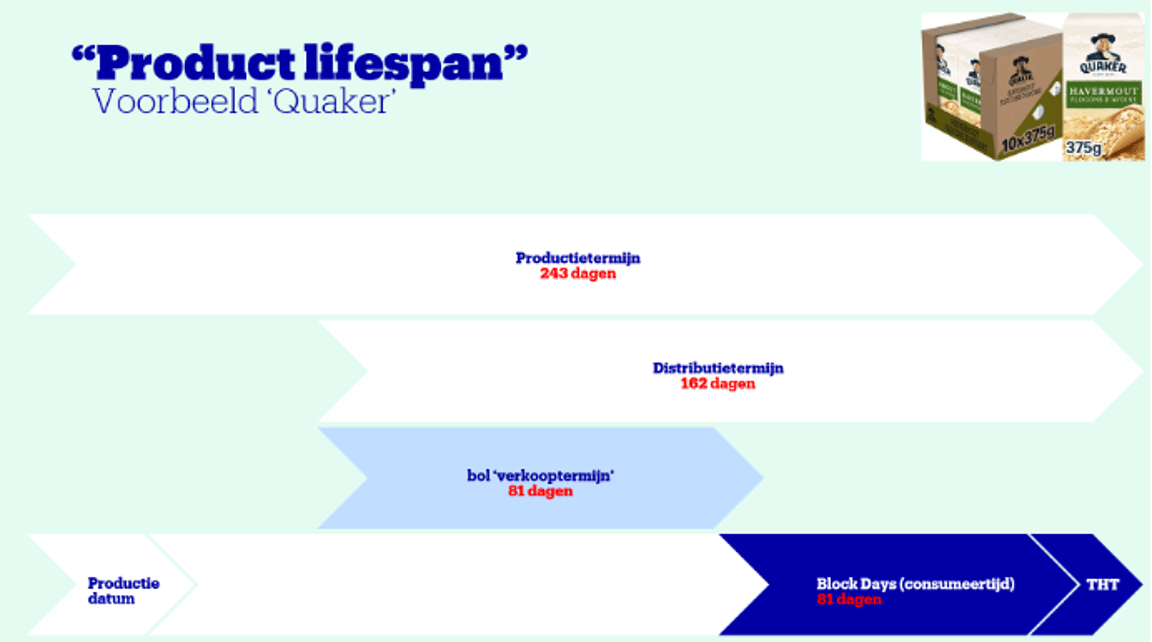
As a partner, you can provide your distribution period per EAN via Partnerservice. If you do not provide this and the item is new to bol, we will automatically use 100 Block Days.
You are responsible for monitoring the sales periods of your Logistics via bol stock. To ensure this process runs smoothly, it is important that you have provided the correct ‘Block Days’ immediately.
Is the end of the sales period approaching? You can do the following to sell your stock faster:
- Promotions
- Selling price reduction
- Increase visibility through sponsored products
Return stock
If you wish to have stock returned from the BFC to you, you can do so following the standard return process. Make sure to request your stock return before the sales period ends. Once items no longer have a sales period, we remove them from the BFCs.
For THT items, we apply a surcharge per sold item according to the prices on this page.
Frequently asked questions
About storing items with an expiration date.