
Computer & Electronics
Find all information regarding the assortment policy for the Computer & Electronics category here.
CE-Kennzeichnung
Um anzuzeigen, dass Ihre artikel die Anforderungen in Bezug auf Sicherheit, Gesundheit und Umwelt erfüllen, gibt es die sogenannte CE-Kennzeichnung. Für die meisten artikel, die in der Europäischen Union (EU) auf den Markt gebracht werden, ist diese Kennzeichnung sogar verpflichtend!
Lesen Sie das Whitepaper
Möchten Sie wissen, wie das genau funktioniert? In diesem Whitepaper über Produktsicherheit und eine gültige Konformitätserklärung wird es Ihnen erklärt.
CE-Kennzeichnung in 3 Minuten
Ist die CE-Kennzeichnung auch für Sie verpflichtend?
Eine CE-Kennzeichnung ist für artikel der folgenden Produktgruppen verpflichtend (beachten Sie, dies bedeutet nicht, dass Sie all diese artikel auch über bol verkaufen können):
- Sprengstoffe für zivile Zwecke
- Pyrotechnische artikel
- Bauprodukte
- Spielzeug
- Persönliche Schutzausrüstung
- Elektrische, elektronische und energiebezogene artikel
- Medizinprodukte (beachten Sie: hierfür gelten zusätzlich zu den CE-Kennzeichnungen noch spezifische Richtlinien, die Sie erfüllen müssen. Sie können dies in dieser Nachricht und im Medizinprodukte-Beleid nachlesen)
- Mess- und Wiegegeräte
- Maschinen und zugehörige artikel
- Transportmittel
Ergreifen Sie die folgenden Maßnahmen, um sicherzustellen, dass Ihr Sortiment die Anforderungen der CE-Kennzeichnung erfüllt:
- Es ist verpflichtend, die Produktinformationen 'CE-Kennzeichnung' auszufüllen, die unter den optionalen Informationen im verkäuferkonto verfügbar sind. Sie können über ein Dropdown-Menü angeben, ob die CE-Kennzeichnung auf Ihrem artikel, auf der Verpackung Ihres artikels oder in einer Anleitung Ihres artikels 'sichtbar' ist. Wenn Ihr artikel nicht unter die CE-Vorschriften fällt, können Sie 'nicht zutreffend' auswählen. Wir werden diese Produktinformationen überprüfen. Für bestehendes Sortiment ist es nicht verpflichtend, ein Foto hochzuladen.
- Für ein neues Sortiment müssen Sie ein Foto der CE-Kennzeichnung (JPEG- oder PDF-Dateityp) hochladen, die auf dem artikel angebracht ist. Ist dies technisch nicht möglich, genügt ein Foto der CE-Kennzeichnung auf der Verpackung oder in der Anleitung. Anweisungen und Beispiele zum Hinzufügen der CE-Kennzeichnung finden Sie hier.
- Der Handelsname und die Kontaktadresse des Herstellers oder Importeurs in Europa:
Für bestehendes und neues Sortiment bitten wir Sie, das Textattribut ‘Handelsname und Kontaktadresse des Herstellers oder Importeurs in der EU’ bei den optionalen Informationen im verkäuferkonto auszufüllen. Hier müssen Sie den Namen und die Kontaktadresse des Herstellers oder Importeurs in der EU eintragen. Die eingegebenen Informationen werden nicht auf bol sichtbar sein, und wir suchen auch nicht nach dem Einkaufskanal. Hiermit erklären Sie, dass die eingegebenen Informationen auch auf dem artikel oder der Verpackung sichtbar/vorhanden sind.
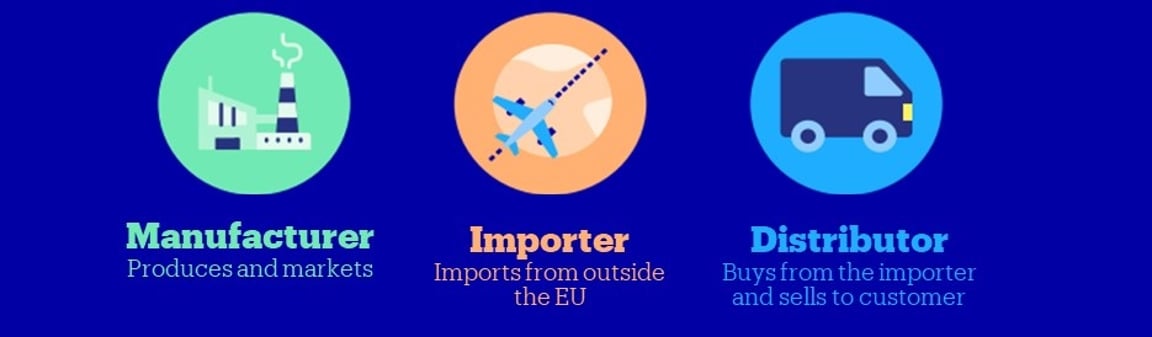
- Verkaufen Sie einen artikel aus einem Land außerhalb der EU und verkaufen Sie diesen unter dem Markennamen dieses Herstellers. Dann sind Sie ein Importeur mit den entsprechenden Verantwortlichkeiten.
- Verkaufen Sie einen artikel, den Sie von einem Partner innerhalb der EU gekauft haben. Zum Beispiel von einem Importeur, einem europäischen Hersteller oder einem anderen Distributeur, dann sind Sie ein Distributeur.
- Handelt es sich um Spielzeug und hat der artikel Sicherheitshinweise, fügen Sie diese bitte in den textuellen Produktinformationen unter 'Sicherheitshinweise' hinzu.
- Stellen Sie sicher, dass Sie die Dokumentation und die Konformitätserklärung, die zum artikel gehören, verfügbar haben. Sowohl bol als auch die Behörden können danach fragen.
- Die Website der RVO;
- Die Website der Europäischen Kommission;
- Unsere Ökosystempartner, die Sie beraten können; und
- Unser Beleid auf dem Partnerplatform mit zugehörigem Video und Infosheet.
Wie verwenden Sie die CE-Kennzeichnung?
Die CE-Kennzeichnung ist an dem bekannten CE-Zeichen erkennbar und muss auf dem artikel oder einem darauf angebrachten Typenschild angebracht werden. Ist dies technisch nicht umsetzbar, dürfen Sie die CE-Kennzeichnung auf der Produktverpackung oder in einem Begleitdokument anbringen (das richtige Bild finden Sie hier).
Was, wenn Sie dieser Verpflichtung nicht nachkommen?
Die (Sicherheits-)Regeln sind gesetzlich festgelegt – und somit müssen Sie nachweisen können, dass Sie über die notwendige(n) CE-Kennzeichnung(en) verfügen. Andernfalls verstoßen Sie gesetzlich gegen die Vorschriften. Wenn Sie unser Beleid nicht erfüllen, wird Ihr artikel offline genommen. All dies, um zu verhindern, dass Kunden durch möglicherweise unsichere artikel gefährdet werden.
Möchten Sie weitere Informationen einholen?
Um alle Anforderungen an die Produktsicherheit zu erfüllen, helfen Ihnen unsere Ökosystempartner gerne weiter. Sie bieten auch Beratung und Unterstützung bei Tests, Zertifizierung, Kennzeichnungen, Qualitätssicherung, Etikettierung, dem Verfassen von Anleitungen und dem Design von Verpackungen. Erfahren Sie mehr über unsere Ökosystempartner und wie sie Ihnen auf unserem Partnerplatform Produktsicherheit helfen können.
E-Waste/Stichting Open
Verordnung über Elektro- und Elektronikaltgeräte (WEEE)/Stichting Open
Halten Sie sich an die gesetzlichen Vorschriften für Elektrogeräte
Sind Sie ein Unternehmer, der Geräte, Lampen oder Batterien auf den niederländischen Markt bringt oder dort verkauft? Dann könnten Sie von der „Herstellerverantwortung“ betroffen sein. Dies ist der Fall, wenn Sie die artikel beispielsweise aus dem Ausland (innergemeinschaftlicher Erwerb) importieren. Wenn Sie unter diese Regelung fallen, sind Sie gesetzlich verpflichtet, diese artikel sicher und verantwortungsvoll zu sammeln und zu verarbeiten.
Diesen Prozess müssen Sie nicht alleine bewältigen. Melden Sie sich bei Stichting OPEN an, der niederländischen Organisation, die im Namen von Importeuren und Herstellern von Geräten, Batterien und Lampen diese Herstellerverantwortung umsetzt. Stichting OPEN arbeitet dabei mit Sammel-, Sortier-, Recycling- und anderen Ökosystempartnern zusammen. Gut geregelt und gut für die Umwelt, denn Bestandteile, Materialien und Rohstoffe bleiben erhalten. Auch für partner gelten diese Regeln. Hier sind sie zusammengefasst.
Regeln für Hersteller und Importeure: Registrierung und Berichterstattung bei Stichting OPEN
Um zu erfahren, ob die Regeln der Herstellerverantwortung auch für Sie gelten, müssen Sie mindestens eine der folgenden Fragen mit 'Ja' beantworten können:
- Produzieren Sie Elektrogeräte in den Niederlanden und bringen diese dort auf den Markt?
- Kaufen Sie Elektrogeräte im Ausland und bringen diese auf den niederländischen Markt?
- Haben Sie Ihren Sitz im Ausland und verkaufen Elektrogeräte direkt an niederländische Verbraucher?
Es ist gut zu wissen, dass fast alle artikel, die Elektrizität nutzen, unter die Regelung fallen, also alle Geräte mit einem Stecker oder einem Batteriefach. Sind Sie unsicher? Dann sprechen Sie mit Stichting OPEN.
Klicken Sie hier für weitere Informationen und häufig gestellte Fragen zu Stichting Open
Regeln für Händler: Alt-gegen-Neu-Regelung
In den Niederlanden sind Elektronikgeschäfte verpflichtet, alte Geräte beim Verkauf neuer Geräte zurückzunehmen (die „Alt-gegen-Neu“-Regelung). Kauft der Kunde online ein Elektrogerät oder eine energiesparende Lampe, ist der Händler ebenfalls verpflichtet, ein ähnliches artikel zurückzunehmen. (Online-)Shops sind verpflichtet, die „Alt-gegen-Neu“-Regelung ihren Kunden deutlich anzubieten, bevor der Bezahlvorgang auf der Website abgeschlossen ist.
Achtung!
Verkaufen Sie (elektronische und/oder elektrische) artikel mit nicht vom Verbraucher entfernbaren Teilen, also eWaste? Dann ist es verpflichtend, beim artikelmerkmal 'eWaste' in den artikelinformationen dieser artikel 'ja' anzugeben.
Amazon
To prevent confusion for our customers, it is not permitted to sell own-brand items from other online shopping platforms. For example, items from the brand or AmazonBasics.
Rejected items
bol highly values your safety and health. That's why we always carefully review items that could pose risks, even if there isn't yet any specific legislation or regulations. If an item is potentially harmful, it will be placed on the Safety Gate list. You are then not allowed to sell these items via bol.
Symbol for separate collection
All electrical and electronic items must display the symbol for separate collection: a crossed-out wheeled bin. This symbol indicates that the items do not belong with general waste. If this marking is not possible due to the size or function of the item, the symbol may also be placed on the packaging, user manual, or warranty certificate. More information about this symbol and its appearance can be found here: National (W)EEE Register.
Plug Connections
Together, we offer our customers in the Netherlands and Belgium a wide range of items. Our goal is that these items can be used by our customers without any issues. That's why we do not sell appliances without a Dutch or Belgian plug. We also do not sell appliances that have a travel adapter. A travel adapter is an attachment that makes a plug suitable for a Belgian or Dutch socket.
Product description
The Electronics category often includes complex items where the user needs extra explanation for installation or use. Therefore, make sure you help the customer with a good item description, and don't just repeat the item title.
Home Copy Fee
Do you sell storage items like smartphones, DVDs, USB sticks, or external hard drives? Then, as a partner, you must pay a home copy fee. This fee is for artists and authors who lose income because their work is copied by customers onto these devices.
- Are you selling in the Netherlands? Go to Stichting de Thuiskopie
- Are you selling in Belgium? Go to Auvibel
Walkie-talkies
The following conditions apply to selling walkie-talkies:
Frequencies and Transmit Power:
Walkie-talkies must operate within the license-free frequency bands:
- 434.040 MHz to 434.790 MHz with a maximum transmit power of 10 mW e.r.p.
- 446.00 MHz to 446.200 MHz with a maximum transmit power of 500 mW e.r.p.
Manufacturer Obligations:
- Mention of Frequencies and Transmit Power: The manufacturer must explicitly state the frequencies and transmit power in the manual, so the user knows which rules apply to the device.
- Fixed Antenna: The walkie-talkie must have a fixed, non-removable antenna. This prevents users from replacing the antenna with a higher-gain antenna, which could lead to exceeding the legal power limits.
- CE Marking and Declaration of Conformity: The item must have a CE marking, indicating compliance with European regulations for safety, health, and environment. Additionally, a Declaration of Conformity must be available, in which the manufacturer confirms that the item complies with the relevant EU directives.
Manual:
A manual must be included, either in Dutch or English.
Keyboards
To prevent compatibility issues, it is not possible to offer AZERTY keyboards in the Netherlands.
However, it is possible to offer QWERTY keyboards in Belgium.
Gas connection for gas stoves and hobs
To protect the safety of our customers, we only offer gas stoves and hobs on our platform that are specifically made for use in the Netherlands or Belgium. This is important because gas stoves and hobs designed for a specific country can cause dangerous situations when used in a country for which they are not intended. Therefore, we limit our offer to models that meet the specific requirements of these two countries.
Right to updates
Customers have the right to updates for smart devices (such as phones, tablets, televisions, and laptops) and for digital content (such as e-books and software). The partner is responsible for this. By law, as a provider, you are obliged to inform your customer about the availability of these updates, and the installation instructions must also be clear. Therefore, ensure that the mandatory content (support with updates) is up-to-date and complete, and prevent items from being taken offline.
Mobile phones 2G network
As of December 1, 2024, the 2G network will be switched off by various providers. This means that mobile phones using 2G will no longer be supported. To make sure customers don't buy phones they can't use, we will remove 2G phones from our product range starting December 1, 2024. Therefore, it will no longer be allowed to offer these items.
Was ist die UPV?
UPV steht für Erweiterte Herstellerverantwortung. Dies ist eine Umweltmaßnahme, die Hersteller für den gesamten Lebenszyklus ihrer Artikel verantwortlich macht, einschließlich der Abfallphase. Mit Hersteller meinen wir die Partei, die einen Artikel zum ersten Mal auf den Markt in den Niederlanden und/oder Belgien bringt. Dies kann also auch Sie als Partner betreffen, wenn Sie Artikel zum ersten Mal auf den Markt bringen.
Unternehmen, die Artikel auf dem belgischen oder niederländischen Markt anbieten, müssen zur Finanzierung und Organisation der Sammlung, umweltfreundlichen Verarbeitung und des Recyclings dieser Artikel am Ende ihrer Lebensdauer beitragen.
Das Ziel der UPV ist es, die Umweltauswirkungen von Artikeln zu verringern, indem Abfall reduziert, Recycling gefördert und die Kosten für die Abfallwirtschaft beim Hersteller angesiedelt werden.
Partner dürfen nur über bol in Belgien und den Niederlanden verkaufen, wenn sie die geltenden UPV-Vorschriften erfüllen. Wenn Partner diese nicht erfüllen, ist bol gesetzlich verpflichtet, das betreffende Sortiment offline zu nehmen. bol wird dies zukünftig auch durchsetzen.
Kollektive oder individuelle Abgabe
In Belgien und den Niederlanden müssen Unternehmen, die bestimmte Artikelkategorien auf den Markt bringen, die UPV-Vorschriften erfüllen. Für Partner von bol bedeutet dies, dass sie sich einer Verwaltungsgesellschaft anschließen müssen, die die UPV kollektiv organisiert und erleichtert, und dafür einen finanziellen Beitrag leisten müssen.
Als Hersteller treten Sie der Verwaltungsgesellschaft bei, indem Sie eine Beitrittsvereinbarung unterzeichnen. In den Tabellen auf dieser Seite sehen Sie, auf welche Artikel und Artikelbestandteile dies in jedem Fall zutrifft. Bitte beachten Sie, dass die Verpflichtung auch für andere nicht genannte Kategorien gelten kann.
Weitere Informationen finden Sie auf den Websites der Verwaltungsgesellschaften.
Verwaltungsgesellschaften UPV - Belgien
Verwaltungsgesellschaften UPV - Niederlande
Bitte beachten Sie: Die oben genannten Listen sind nicht vollständig. Sie sind als Partner selbst dafür verantwortlich, die für Ihr Sortiment geltenden Abgaben einzuhalten. Lassen Sie sich bei Bedarf dazu beraten.
Wenn Sie Artikel innerhalb dieser Kategorien produzieren, importieren oder verkaufen, müssen Sie die UPV erfüllen, indem Sie sich einer anerkannten Verwaltungsgesellschaft anschließen. Sie können sich auch dafür entscheiden, individuell für eine umweltfreundliche Verarbeitung Ihrer Artikel zu sorgen. Dann reichen Sie einen individuellen Annahmepflichtplan bei der OVAM für Artikel ein, die Sie als Erster in Belgien auf den Markt bringen. Darin erläutern Sie, wie Sie die Sammlung, Verarbeitung und Präventionsmaßnahmen organisieren. Sie berichten auch jährlich über die Umsetzung des Plans. Weitere Informationen finden Sie auf dieser Seite.
Verkaufen Sie als nicht-belgischer Partner an belgische Kunden?
Achten Sie dann genau darauf.
Sind Sie als Unternehmen außerhalb Belgiens ansässig und verkaufen Sie Artikel an belgische Verbraucher oder Unternehmen, zum Beispiel über bol? Dann kann es sein, dass Sie einen Bevollmächtigten in Belgien bestellen müssen. Ein Bevollmächtigter ist eine Person oder Organisation in Belgien, die Ihre gesetzlichen Verantwortlichkeiten übernimmt. Die Verantwortlichkeiten sind dieselben wie die eines belgischen Herstellers.
Wichtig: Sie müssen diesen Bevollmächtigten offiziell durch eine schriftliche Vollmacht bestellen, bevor Sie Artikel in Belgien anbieten.
Einige Verwaltungsgesellschaften können selbst als Bevollmächtigte auftreten. In diesem Fall schließen Sie als nicht-belgischer Partner direkt einen Vertrag mit ihnen ab, um sicherzustellen, dass Sie alle Verpflichtungen erfüllen. Bitte beachten Sie: Verwaltungsgesellschaften sind hierzu nicht verpflichtet, besprechen Sie dies also immer im Voraus.
Weitere Informationen erhalten Sie bei den Verwaltungsgesellschaften oder der OVAM.
Verpflichtung von bol als Online-Marktplatz
In Kürze wird bol auch bei Partnern durchgreifen, die die UPV-Verpflichtungen innerhalb bestimmter Produktkategorien nicht erfüllen. bol ist gesetzlich verpflichtet, Partner, die unter die UPV-Regelung fallen und keinen Beitrag leisten, vom Verkauf auszuschließen. In den Niederlanden gilt diese Verpflichtung für Batterien und wird voraussichtlich langfristig auch für andere Produktkategorien gelten. In Belgien gilt diese Verpflichtung für alle Kategorien.
Verkaufen Sie Artikel innerhalb der UPV-Kategorien? Dann müssen Sie Folgendes tun, um weiterhin verkaufen zu dürfen:
- Verkaufsrechte beantragen, oder
- Sich bei den Verwaltungsorganisationen anmelden.
Weitere Informationen zur Beantragung von Verkaufsrechten finden Sie auf dieser Seite.
Universele opladers
On 28 December 2024, the EU introduced new legislation (Directive (EU) 2022/2380) for standardising chargers and charging specifications of electronic devices.
Read more about this legislation.
For certain items, it’s mandatory to specify whether the item is delivered with or without a charger and what the charging specifications for the device are. It concerns the following information:
- The minimum power the device requires to be charged.
- The maximum power the device requires to achieve maximum charging speed.
- Whether the device supports fast charging.
You can find this information in the manual, the technical data sheets, or on the manufacturer’s website.
You provide this information with your offer. For new items in certain categories, it’s mandatory to provide this information. After filling it in, the information is visible in the form of pictograms on the product page. It concerns the following attributes:
- Including adapter(s)
- Maximum power to charge
- Minimum power to charge
- Fast-charging functionality
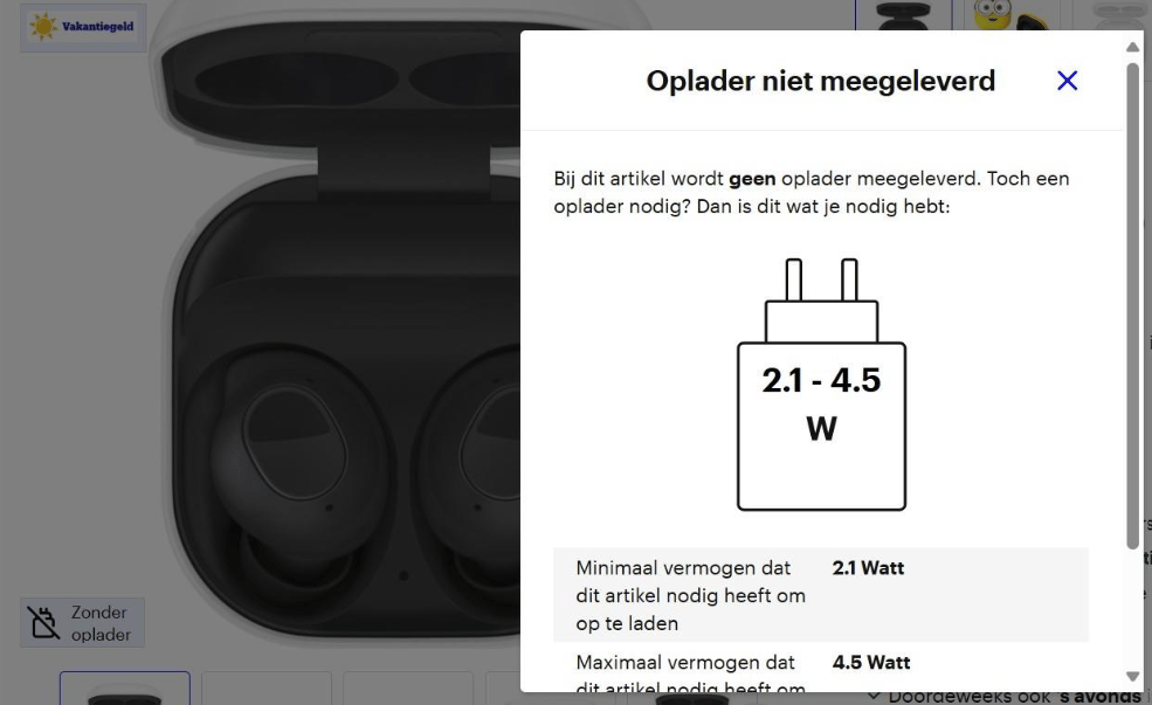
It concerns the following items:
- Mobile telephones
- Tablets
- Digital cameras
- Headphones
- Portable speakers
- Portable navigation systems
- In-ear headphones
- Headsets
- Portable videogame consoles
- e-readers
- Keyboards
- Computer mice
- Laptops
Additional obligation
The law requires consumers to have the option of purchasing an item without a charger. If you sell an item with a charger, you are legally required to offer it without 1 as well. This reduces electronic waste and customers have more to choose from. Win-win!