
Health
Find all information regarding the assortment policy for the Health category here.
Health claims
A health claim creates the impression that there's a positive link between a food (or a component thereof) and health. Health claims can be about physical effects, psychological effects, slimming, weight management, or reducing health risks.
Health claims are prohibited, unless they're the same as the general requirements of Regulation (EC) No. 1924/2006 and a permit has been granted for the claim. This will then be included in Regulation (EC) No. 432/2012. When you place health claims on the product photo or in the description, please take the guidelines of the European Claims Regulation 655/2013 into account.
Here are examples of health claims that are not allowed:
- Claims that give the impression that not taking the food can negatively affect health
- Claims about how quickly or how much weight you can lose
- Claims that use recommendations from individual doctors or professionals in the field of public health and other legislation
Coronavirus
To prevent misleading a customer, it is not permitted to mention the coronavirus in the item photo, title, or description.
Check if your claim is allowed with this handy claim database: > Go to the claim database of the Keuringsraad KOAG/KAG
European legislation on explosives precursors
Precursors are substances that can be found in everyday household items and can be used for making explosives. That's why European legislation restricts (the use of) these substances. From 1 February 2021, European Regulation 2019/1148 on explosives precursors applies. This European legislation also applies in the Netherlands. Read more.
CE-Kennzeichnung
Um anzuzeigen, dass Ihre artikel die Anforderungen in Bezug auf Sicherheit, Gesundheit und Umwelt erfüllen, gibt es die sogenannte CE-Kennzeichnung. Für die meisten artikel, die in der Europäischen Union (EU) auf den Markt gebracht werden, ist diese Kennzeichnung sogar verpflichtend!
Lesen Sie das Whitepaper
Möchten Sie wissen, wie das genau funktioniert? In diesem Whitepaper über Produktsicherheit und eine gültige Konformitätserklärung wird es Ihnen erklärt.
CE-Kennzeichnung in 3 Minuten
Ist die CE-Kennzeichnung auch für Sie verpflichtend?
Eine CE-Kennzeichnung ist für artikel der folgenden Produktgruppen verpflichtend (beachten Sie, dies bedeutet nicht, dass Sie all diese artikel auch über bol verkaufen können):
- Sprengstoffe für zivile Zwecke
- Pyrotechnische artikel
- Bauprodukte
- Spielzeug
- Persönliche Schutzausrüstung
- Elektrische, elektronische und energiebezogene artikel
- Medizinprodukte (beachten Sie: hierfür gelten zusätzlich zu den CE-Kennzeichnungen noch spezifische Richtlinien, die Sie erfüllen müssen. Sie können dies in dieser Nachricht und im Medizinprodukte-Beleid nachlesen)
- Mess- und Wiegegeräte
- Maschinen und zugehörige artikel
- Transportmittel
Ergreifen Sie die folgenden Maßnahmen, um sicherzustellen, dass Ihr Sortiment die Anforderungen der CE-Kennzeichnung erfüllt:
- Es ist verpflichtend, die Produktinformationen 'CE-Kennzeichnung' auszufüllen, die unter den optionalen Informationen im verkäuferkonto verfügbar sind. Sie können über ein Dropdown-Menü angeben, ob die CE-Kennzeichnung auf Ihrem artikel, auf der Verpackung Ihres artikels oder in einer Anleitung Ihres artikels 'sichtbar' ist. Wenn Ihr artikel nicht unter die CE-Vorschriften fällt, können Sie 'nicht zutreffend' auswählen. Wir werden diese Produktinformationen überprüfen. Für bestehendes Sortiment ist es nicht verpflichtend, ein Foto hochzuladen.
- Für ein neues Sortiment müssen Sie ein Foto der CE-Kennzeichnung (JPEG- oder PDF-Dateityp) hochladen, die auf dem artikel angebracht ist. Ist dies technisch nicht möglich, genügt ein Foto der CE-Kennzeichnung auf der Verpackung oder in der Anleitung. Anweisungen und Beispiele zum Hinzufügen der CE-Kennzeichnung finden Sie hier.
- Der Handelsname und die Kontaktadresse des Herstellers oder Importeurs in Europa:
Für bestehendes und neues Sortiment bitten wir Sie, das Textattribut ‘Handelsname und Kontaktadresse des Herstellers oder Importeurs in der EU’ bei den optionalen Informationen im verkäuferkonto auszufüllen. Hier müssen Sie den Namen und die Kontaktadresse des Herstellers oder Importeurs in der EU eintragen. Die eingegebenen Informationen werden nicht auf bol sichtbar sein, und wir suchen auch nicht nach dem Einkaufskanal. Hiermit erklären Sie, dass die eingegebenen Informationen auch auf dem artikel oder der Verpackung sichtbar/vorhanden sind.
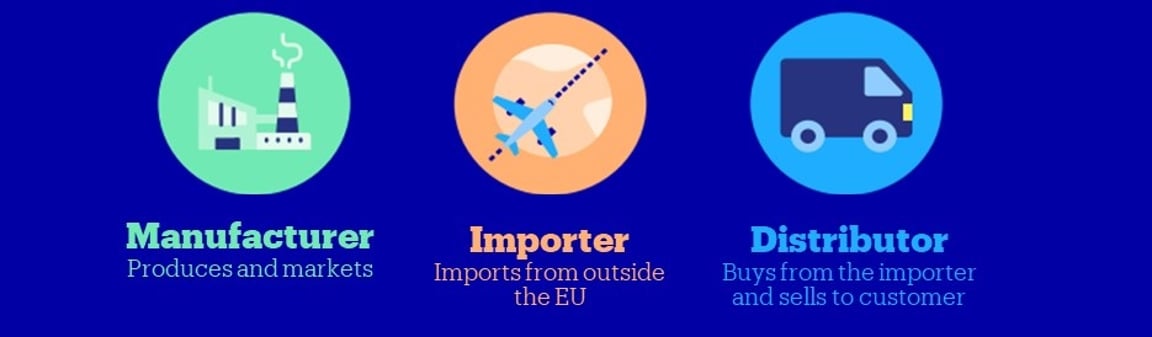
- Verkaufen Sie einen artikel aus einem Land außerhalb der EU und verkaufen Sie diesen unter dem Markennamen dieses Herstellers. Dann sind Sie ein Importeur mit den entsprechenden Verantwortlichkeiten.
- Verkaufen Sie einen artikel, den Sie von einem Partner innerhalb der EU gekauft haben. Zum Beispiel von einem Importeur, einem europäischen Hersteller oder einem anderen Distributeur, dann sind Sie ein Distributeur.
- Handelt es sich um Spielzeug und hat der artikel Sicherheitshinweise, fügen Sie diese bitte in den textuellen Produktinformationen unter 'Sicherheitshinweise' hinzu.
- Stellen Sie sicher, dass Sie die Dokumentation und die Konformitätserklärung, die zum artikel gehören, verfügbar haben. Sowohl bol als auch die Behörden können danach fragen.
- Die Website der RVO;
- Die Website der Europäischen Kommission;
- Unsere Ökosystempartner, die Sie beraten können; und
- Unser Beleid auf dem Partnerplatform mit zugehörigem Video und Infosheet.
Wie verwenden Sie die CE-Kennzeichnung?
Die CE-Kennzeichnung ist an dem bekannten CE-Zeichen erkennbar und muss auf dem artikel oder einem darauf angebrachten Typenschild angebracht werden. Ist dies technisch nicht umsetzbar, dürfen Sie die CE-Kennzeichnung auf der Produktverpackung oder in einem Begleitdokument anbringen (das richtige Bild finden Sie hier).
Was, wenn Sie dieser Verpflichtung nicht nachkommen?
Die (Sicherheits-)Regeln sind gesetzlich festgelegt – und somit müssen Sie nachweisen können, dass Sie über die notwendige(n) CE-Kennzeichnung(en) verfügen. Andernfalls verstoßen Sie gesetzlich gegen die Vorschriften. Wenn Sie unser Beleid nicht erfüllen, wird Ihr artikel offline genommen. All dies, um zu verhindern, dass Kunden durch möglicherweise unsichere artikel gefährdet werden.
Möchten Sie weitere Informationen einholen?
Um alle Anforderungen an die Produktsicherheit zu erfüllen, helfen Ihnen unsere Ökosystempartner gerne weiter. Sie bieten auch Beratung und Unterstützung bei Tests, Zertifizierung, Kennzeichnungen, Qualitätssicherung, Etikettierung, dem Verfassen von Anleitungen und dem Design von Verpackungen. Erfahren Sie mehr über unsere Ökosystempartner und wie sie Ihnen auf unserem Partnerplatform Produktsicherheit helfen können.
Tabak & Drogen
bol entscheidet sich dafür, den Konsum von Tabak oder weichen und harten Drogen nicht zu fördern, weshalb der verkauf der folgenden artikel über bol nicht gestattet ist:
- Tabak und andere Rauchwaren, die unter das Tabak- und Rauchwarengesetz fallen. Darüber hinaus geht bol über das Gesetz hinaus, und es ist auch nicht gestattet, Zigarettenhersteller oder Zubehör mit Aroma zu verkaufen, wie Aromakarten, Aromafilter, Aromablättchen und Aromaliquids.
- artikel, die unter das Opiumgesetz fallen.
- E-Zigaretten, Vaporizer und alle anderen artikel, die zum Konsum von Nikotin (oder einer nikotinfreien Substanz) verwendet werden können und über ein Mundstück Dampf erzeugen. Auch Teile und Zubehör für diese artikel, einschließlich Nachfüllpackungen, Kartuschen, Tanks und Kits, dürfen nicht über bol verkauft werden.
- Pfeifen, Wasserpfeifen, Cannabis-Pfeifen und Bongs. Auch Teile und Zubehör für diese artikel dürfen nicht über bol verkauft werden.
- artikel, die mit der Herstellung und dem Konsum von weichen und harten Drogen in Verbindung gebracht werden können. Dazu gehören unter anderem (elektrische) Grinder, Jointhülsen & -roller, Rolling Trays & Boxen und Cannabissamen.
- Sahnekapseln.
- Aschenbecher
- Feuerzeuge
- CBD-artikel, solange diese den geltenden Gesetzen und Vorschriften in den Niederlanden und Belgien entsprechen
- Elektrische Kräutermühlen
- Zigaretten- & Zigarrenschachteln
Medicines
There are different types of medicines. You can sell General Sale (AV) medicines via bol if you have selling rights. For every medicine offered for sale (online) in the EU, there is a marketing authorization issued by the EMA (Europe) or the CBG (Netherlands). The approved medicines for human use and their marketing authorization can be found in the medicines information database.
It is not possible to sell Prescription Only (UR) medicines or Pharmacy Only (UA) medicines via bol.
Natural Erection Pills
Erection pills, such as Viagra, are a simple way to make your penis harder and keep it hard for longer. Due to the active ingredients such as sildenafil, vardenafil, and tadalafil, these products are only available by prescription from your (general) doctor. Natural erection pills are, in principle, supplements that do not contain any of these active ingredients. However, regulators are increasingly warning that these substances may still be present. Therefore, it is not allowed to sell (natural) erection pills on bol. Listing these products under other names such as 'Libido enhancers' or 'Aphrodisiacs' is considered deliberate deception and will be strictly enforced on through policy measures.
Partners who have the sales rights for Medicines Netherlands may, under certain conditions, offer this product range. The range of natural erection pills that is currently allowed (under sales rights) on bol comes from a wholesaler based in the EU. Below is a list of the products that may currently be sold:
Teeth whitening products
The safety and health of our customers is our top priority. It is therefore important that partners selling teeth whitening products adhere to the legally permitted maximum percentage of hydrogen peroxide. Therefore, it is mandatory to specify the percentage of hydrogen peroxide (H2O2) contained in the item under the 'percentage hydrogen peroxide H2O2' attribute.
Melatonin
There is a legal maximum daily dose for the free sale of melatonin (supplements). Items that can result in a daily dose of 0.3 milligrams or more of melatonin are considered medicinal products by the Health and Youth Care Inspectorate (IGJ). Because these items fall under the Medicines Act, they are not suitable for selling via bol. Melatonin (supplements) with a maximum daily dose of up to 0.3 milligrams remain permitted. The IGJ considers these to be food supplements.
Daily dose < 0.3 mg melatonin
- Items containing a maximum of 0.299 mg of melatonin are classified as food supplements.
- Claims about sleep or rest are not permitted if the item exclusively contains melatonin; claims about other ingredients (if present) are permitted.
Daily dose ≥ 0.3 mg melatonin
- Items with a daily dose of 0.3 mg of melatonin or more are considered UAD products (Pharmacy and Drugstore Only) by the Health and Youth Care Inspectorate (IGJ).
- To offer these items, Sales rights for medicinal products are required.
- These items must be registered in the medicinal product information database.
Food supplements (FASFC) – BE
Do you want to offer food supplements for the Belgian market via bol? Then your organization must be registered with the FASFC (Federal Agency for the Safety of the Food Chain) with a distribution authorization.
Guidelines in Belgium
All organizations active in the food chain in Belgium and having a warehouse in Belgium must be known to and registered with the FASFC. This includes offering notified food supplements.
Notified food supplements
Partners who wish to sell food supplements in Belgium may only sell notified food supplements. These are food supplements that must be officially registered with the Belgian government before they can be placed on the market. If you wish to offer food items that are not yet known to us as notified, you can send a list of these EANs, including notification numbers, to gezondheid@bol.com. We will check this list and approve it if the notifications are in order. It may take up to 2 weeks for your application to be processed, as this verification process involves a lot of manual work.
FASFC registration
You can register your organization with the FASFC via this link.
Offering food supplements in Belgium with a warehouse in the Netherlands
If you are a Dutch company with only a warehouse in the Netherlands and you wish to offer food supplements in Belgium from there, you do not need an FASFC registration. You can apply for selling rights for food supplements in Belgium without providing an FASFC registration, by demonstrating that your company is located in the Netherlands. You may only sell notified food supplements in Belgium.
How will your application to bol be assessed?
To offer notified food supplements to Belgian customers, you must therefore be able to demonstrate that you are officially registered with the FASFC or that your company is located in the Netherlands. For this, we need your FASFC registration number or business address.
Disinfectants
Legal rules apply to the selling via bol of disinfectants. This includes items such as:
- Disinfectant hand gels
- Disinfectant wipes
- Hand alcohol
Food and Beverages for Human Consumption
To ensure that all food and beverages on our platform are safe and pose no health risks to our customers, you must comply with legal requirements and regulations. This applies to all consumer target groups.
- Which items do we allow?
- Food items (human & animal) with a shelf life of at least 100 days after arrival at our customers;
- Food items for which a suitable product category is available;
- The mandatory food content must be clearly displayed on the label in the language of the country where it is sold. This means, at minimum, in Dutch for items for the Dutch market and in French and Dutch for items for the Belgian market.
- Which items do we not allow?
- Private label items from other supermarkets. For example, items from Albert Heijn's house brand;
- Food items that require refrigeration or freezing;
- Fresh or dried animal products intended for human consumption;
- Items, including composite food packages, where the exact contents of the packaging are not specified;
- Food and beverages containing CBD. CBD is only permitted in supplement form. See the CBD policy for more information;
- Alcoholic beverages with an alcohol percentage higher than 1.2%. See the Alcoholic Beverages policy for more information;
- Items with poorly substantiated product claims that do not fit within our policy on product claims.
Legal Obligations
In addition to the above guidelines that apply on the bol platform when selling food items, you must also be aware of the legal obligations that you, as a provider, must meet. Pay close attention to the following points:
- The GTIN/EAN of the item must be registered with GS1. The complete label content must also be available in a GS1 GDSN data pool. This is GS1 Data Source (Netherlands) or GS1 My Product Manager (Belgium). For more information, go to our page at GS1 Netherlands or here at GS1 Belgium.
- For items with animal ingredients, the manufacturer must be registered as a food business in the EU (issued by the NVWA in the Netherlands or the FASFC in Belgium);
- Food items from outside the EU must also be available in a GS1 GDSN data pool and must comply with the conditions for imported products from outside the EU. More information can be found here;
- Only approved food enhancers and additives may be used in the items. More information is available here from the NVWA.
Production Safety
To confirm that your items comply with the guidelines and do not involve food fraud, we may request production documentation, among other things. This must demonstrate compliance with HACCP, such as the food safety plan and hygiene regulations of the product manufacturer. As soon as there is a serious suspicion that a product range is dangerous for the customer, your product range may be temporarily taken offline while we assess the (potentially) dangerous items.
Food Supplements
Food supplements are only permitted if they comply with the above obligations and guidelines. Additional laws and regulations also apply:
- Food and beverages may only contain permitted amounts of certain food supplements (and may not become medicinal products). This also applies to food and beverages for specific consumer target groups, such as babies and toddlers, people with allergies or illnesses, and people who are losing weight. Stricter rules apply here for permitted amounts of certain food supplements.
- Please note: it is prohibited to claim on the label, packaging, or in advertising that the food supplement prevents, treats, or cures a disease.
- Selling food supplements in Belgium? See the self-care policy for more information;
Do you sell bulk packaging?
Ensure you make this clear to the customer. For example, by showing the item in bulk packaging in the main image and clearly stating ‘multi-pack’ or ‘bulk packaging’ in the product title. Also, make sure the product characteristic ‘Packaging Level’ is filled in, and that the official EAN belonging to the bulk packaging (as registered with GS1) is used.
CBD
Cannabidiol (CBD)
To sell items containing CBD (Cannabidiol) safely to our customers (and their pets), we have created additional guidelines. These guidelines apply in addition to existing laws and regulations. For CBD intended for human consumption, you are obliged to comply with the Food and Beverage policy.
CBD for human consumption
- CBD is a food supplement, a concentrated addition to normal nutrition, and is therefore only permitted in the product group for supplements.
- Food and beverages with added CBD are not allowed on our platform. See more information here about the Food and Beverage policy.
- Selling CBD supplements in Belgium? See more information here about selling food supplements in Belgium.
Additional conditions
- It is mandatory to give CBD items a GDSN GS1 registration, so it is clear that the items fall under the category of food supplements. Here you can find more information about GS1 registration in Belgium and the Netherlands.
- Active THC is not allowed, and it is mandatory to state how much THC an item contains. If you do not state this correctly, it will be considered food fraud.
- For the product characteristic ‘Type of herb or plant’, ‘CBD’ must be filled in. It is also mandatory to fill in a percentage for the product characteristic ‘THC content’.
- It is not allowed to make medical or health-related claims about an item. Check this carefully if you make a claim.
- The item may not contain an amount of active substances that would cause it to fall under medicines legislation. More information about this can be found here.
- PLEASE NOTE: for food supplements, strict requirements apply to labels on the packaging. These must be set up correctly with additional information about the name and conditions of use of the item.
CBD for animal consumption
For the safety of our customers' pets, it is important to adhere to the following conditions:
- Only approved hemp varieties may be present in CBD items for animals. See more information here about this legislation.
- It is mandatory to fill in all ingredients of the item in the designated product characteristic. These must match the actual content of the item.
Medical devices
To ensure that all medical devices on our platform are safe and do not pose health risks to our customers, it is important to adhere to all legal requirements and regulations. This applies to all consumer target groups. As a partner, you are always responsible for ensuring that your offer complies with these conditions.
What are medical devices and risk classifications?
A medical device is an item with a medical purpose for the user. This page has more information about the meaning of medical devices. Make sure you clearly understand when your item is a medical device. Please note, for selling via bol in Belgium, these selling rights still apply.
Each medical device is linked to a risk classification, an assessment that evaluates the risk for the customer. Every medical device must have a risk classification. Risk classifications have consequences for the item and the obligations for the partner. Based on the classification, different conditions arise that the item must meet, such as having the item checked by a notified body for a medium or high-risk class. Annex VIII of MDR 2017/745 contains the classification rules for the risk class.
Legislation for medical devices
For medical devices, we are currently in the transition from the Medical Device Directive (MDD) to the Medical Device Regulation (MDR). This means there is a transition period during which medical devices must comply with the new laws and regulations. The current product range must continue to comply with Directive 90/385/EEC and/or Directive 93/42/EEC. If a clear adjustment has been made to the design and/or purpose of the device, the medical device must immediately comply with the MDR.
The transition phase is set for 31 December 2028, until which a specific medical device may still be offered and sold:
· Class IIb devices that are non-implantable.
· Class IIa devices.
· Class I devices that are sterile or have a measuring function.
As of 1 January 2029, the selling via bol of the above medical devices falling under the old legislation will no longer be permitted on our platform.
It is therefore important that you, as a partner, know the risk class of your items. You can find this in the MDR under Annex VIII. If your items already comply with the new MDR legislation, then there is no issue, and your items can continue to be sold via bol. It is your responsibility as a partner to ensure that you will have a new valid declaration of conformity.
Product safety
To confirm that your items comply with the legislation, bol may ask you to provide certain information. This could include, for example, technical documents that demonstrate your adherence to the MDR conditions. Ensure that you always have these available, along with your declaration of conformity. If there is a serious suspicion that the product range is dangerous for the customer, your product range may be temporarily taken offline while the (potentially) dangerous items are assessed.
Selling rights
To offer medical devices on our platform, you need selling rights. You can apply for selling rights via the Partnerplatform.
What is expected of you?
- Manufacturers, European representatives, and importers are required to register in EUDAMED. This is only possible with a GS1 EAN/GTIN. There are no costs associated with the registration.
- Unbranded medical devices are not permitted.
- It is not permitted to make health claims or offer medical measurements without complying with medical device legislation.
- Returned items may not be resold unless they are in their complete original packaging and the safety and effectiveness of the item are guaranteed.
- Storage of medical devices must take place in a temperature-controlled environment.
- For items intended for the Dutch market, a label and manual in Dutch are mandatory. For the Belgian market, a label and manual in Dutch and French are mandatory.
Where can I find more information?
In this infosheet, you will find more information about your obligations as a partner.
Self-tests (Home Tests)
Keeping track of one's own health is becoming increasingly popular. Self-tests make it possible to gain better insight into your health. There are two types of tests:
- Home tests: home tests that consumers can use independently at home, such as pregnancy tests, ovulation, allergy, cholesterol, bladder infection, or corona tests. These are tests where a result is available within minutes. This category is open for selling via bol through sales rights.
- Tests with external (laboratory) analysis: tests where the consumer must send samples such as urine, saliva, or blood to a laboratory for analysis. We consider these tests unsuitable for selling via bol because self-tests must be able to be performed without direct or indirect help from a healthcare professional (European law 2017/746). Additionally, for these services, we have insufficient insight into the processing and protection of customer data in such processes/services.
Please note! Home tests that could have significant health consequences due to (potentially) incorrect diagnostics, such as for HIV or cancer, are prohibited from selling via our platform. This also applies to items that suggest this and/or are offered with other (disguised) wording.Obligations As bol, we believe it is important that customers buy reliable tests, which is why all offered tests must have the following:
- Valid CE marking (incl. a 4-digit code)
- Declaration of Conformity (DoC).
- Dutch user manual
- Correspondence address for questions (this may not be a PO box)
If you want to sell home tests, you must apply for medical device sales rights for them.