
Food & Drinks
Find all information about the assortment policy for the Food & Drinks category, such as alcoholic beverages, food and drink items for human consumption, CBD, and quality marks.
Food and Beverages for Human Consumption
To ensure that all food and beverages on our platform are safe and pose no health risks to our customers, you must comply with legal requirements and regulations. This applies to all consumer target groups.
- Which items do we allow?
- Food items (human & animal) with a shelf life of at least 100 days after arrival at our customers;
- Food items for which a suitable product category is available;
- The mandatory food content must be clearly displayed on the label in the language of the country where it is sold. This means, at minimum, in Dutch for items for the Dutch market and in French and Dutch for items for the Belgian market.
- Which items do we not allow?
- Private label items from other supermarkets. For example, items from Albert Heijn's house brand;
- Food items that require refrigeration or freezing;
- Fresh or dried animal products intended for human consumption;
- Items, including composite food packages, where the exact contents of the packaging are not specified;
- Food and beverages containing CBD. CBD is only permitted in supplement form. See the CBD policy for more information;
- Alcoholic beverages with an alcohol percentage higher than 1.2%. See the Alcoholic Beverages policy for more information;
- Items with poorly substantiated product claims that do not fit within our policy on product claims.
Legal Obligations
In addition to the above guidelines that apply on the bol platform when selling food items, you must also be aware of the legal obligations that you, as a provider, must meet. Pay close attention to the following points:
- The GTIN/EAN of the item must be registered with GS1. The complete label content must also be available in a GS1 GDSN data pool. This is GS1 Data Source (Netherlands) or GS1 My Product Manager (Belgium). For more information, go to our page at GS1 Netherlands or here at GS1 Belgium.
- For items with animal ingredients, the manufacturer must be registered as a food business in the EU (issued by the NVWA in the Netherlands or the FASFC in Belgium);
- Food items from outside the EU must also be available in a GS1 GDSN data pool and must comply with the conditions for imported products from outside the EU. More information can be found here;
- Only approved food enhancers and additives may be used in the items. More information is available here from the NVWA.
Production Safety
To confirm that your items comply with the guidelines and do not involve food fraud, we may request production documentation, among other things. This must demonstrate compliance with HACCP, such as the food safety plan and hygiene regulations of the product manufacturer. As soon as there is a serious suspicion that a product range is dangerous for the customer, your product range may be temporarily taken offline while we assess the (potentially) dangerous items.
Food Supplements
Dietary supplements are only allowed if they meet the obligations and guidelines above. The following additional legal rules also apply:
- Food and drink products may only contain permitted amounts of vitamins, minerals and other substances. Products classed as medicines aren't allowed.
- You can't claim on the label, packaging or in advertising that a dietary supplement prevents, treats or cures a disease. You'll find more information on the Product claims page.
- Do you want to sell dietary supplements in the Netherlands? Then apply for selling rights for dietary supplements in the Netherlands, so you can keep offering dietary supplements after 10 November 2026.
- Do you want to sell dietary supplements in Belgium? Then apply for selling rights for dietary supplements in Belgium.
New brand rules
From 10 November 2026, we'll check all dietary supplements to see whether the brand field contains a brand registered with the BOIP (Benelux Office for Intellectual Property). For supplements from outside the EU, we'll also check that the product information 'Responsible economic operator in the EU' is filled in correctly. If a BOIP-registered brand is missing or this information isn't correct, we'll take the item offline on 10 November 2026.
Do you sell bulk packaging?
Ensure you make this clear to the customer. For example, by showing the item in bulk packaging in the main image and clearly stating ‘multi-pack’ or ‘bulk packaging’ in the product title. Also, make sure the product characteristic ‘Packaging Level’ is filled in, and that the official EAN belonging to the bulk packaging (as registered with GS1) is used.
Alcoholic beverages
You can sell alcohol-free and low-alcohol beverages via our platform, in accordance with the Dutch Commodities Act. Alcohol-free beverages may contain a maximum of 0.1% alcohol, and low-alcohol beverages a maximum of 1.2%. It's important that these beverages are sold in the correct product category. It is not permitted to sell beverages with more than 1.2% alcohol via our platform.
Deposit & excise duty
Deposit in the Netherlands
In the Netherlands, a deposit is charged on packaging, which is added to the purchase price and refunded when returned to a collection point.
- The following packaging has a deposit in the Netherlands:
- Small glass bottles (
- Small plastic 'PET' bottles (< 1 litre) (€ 0.15)
- (Metal) drink packaging (cans) (€ 0.15)
- Large plastic 'PET' bottles (>1 litre) (€ 0.25)
- Packaging of items sold on the Dutch market must have a deposit logo and be registered with Statiegeld Nederland.
- It is not permitted to offer items without a deposit via bol on the Dutch market.
- It is not permitted to charge a deposit on orders that need to be shipped to Belgium.
- The deposit obligation does not apply to cans containing liquids not primarily intended for drinking (such as lemonade syrup, fruit syrup, soups, or condensed milk) or to (canning) cans for non-liquids such as frankfurters, vegetables, etc.
- It is not possible to return deposit items to bol.
- You can check yourself if an item has a deposit. In addition to the deposit logo on the packaging, you can check via this link if the item has a deposit, based on the EAN code. This is the 13-digit code you find under the barcode. Enter it and you will immediately know if the item has a deposit.
- Deposit calculation will be added and calculated during checkout.
- For more information about deposits, go to statiegeldnederland.nl.
- From April 15, 2026, bol will add the deposit amount to the selling price itself at checkout. Therefore, remove the deposit from your selling prices before April 15.
- For each item, you can see in your seller account which deposit amount bol calculates. If this amount is incorrect, first check if the attributes Deposit, Packaging type, Number of units in packaging, and Content per unit are filled in correctly.
- The deposit is listed as a separate line on the invoice and does not count towards commission or VAT.
- The deposit attributes (Deposit, Packaging type, Number of units in packaging, and Content per unit) are mandatory from April 15. If they are missing or incorrectly filled in, items may be taken offline or policy points may be deducted.
- Price comparisons with other providers are exclusive of deposit.
Please note
Are you delivering deposit-free packaging to customers in the Netherlands? Then we will immediately take your deposit offer offline for 3 months.
- We strictly enforce the correct application of the deposit. Examples of checks include:
- Delivering fewer items than shown to the customer
- Delivering an incorrect deposit value
- Delivering a different volume (0.33cl instead of 0.5l) to the customer
- In case of structural violations, a warning will be issued, after which new violations will result in the temporary (3 months) inability to offer deposit items.
Deposit calculation change
From now on, bol will calculate the deposit itself and add it during checkout. Therefore, you must provide the selling price excluding the deposit from then on. This ensures fair price comparisons and correct processing of VAT, sales commission, and reports. The deposit will be listed separately on the invoice and does not count towards the commission.
- This applies to the product categories: Soft drinks, Sports drinks, Juice, Chocolate milk, Dairy drinks, Coffee, Low-alcohol drinks, and Non-alcoholic drinks.
- The following product attributes are mandatory to calculate the deposit: Deposit, Packaging type, Number of units in packaging, and Content per unit.
- If these attributes are not (correctly) filled in for the product categories, we will take the item offline.
Tip: Check if the deposit has been calculated correctly. In your seller account, you will see which deposit value we calculate for your item; if this is incorrect, you can contact Partnerservice.
Deposit Belgium
No deposit obligation in Belgium
- Do you sell products with a deposit as a partner to Belgian customers via bol? In Belgium, no deposit is charged on packaging at the point of purchase. The following applies:
- Belgian customers do not pay Dutch deposit fees at checkout. As a result, the deposit amount is not automatically paid out to you via bol.
- bol ensures that no deposit is charged to customers in Belgium.
- Reclaiming deposit fees via Statiegeld Nederland: If you sell more than €12,500 in deposit value to Belgian customers per year, you can reclaim the deposit yourself via Statiegeld Nederland. This is done through the indirect export scheme. Statiegeld Nederland will pay out 95% of the deposit amount. The remaining 5% is a statutory risk surcharge. For this application, you'll need sales and export documentation, among other things. Statiegeld Nederland assesses and processes these applications directly.
- You can find more information on the website of Recycling Netwerk Benelux.
Excise duty
Excise duty is a form of tax that applies to certain items and is usually already included in the price for the customer. Within the food & drink product category, this concerns excise duties on: alcoholic items. In Belgium, there is also excise duty on coffee, tea, and non-alcoholic drinks.
Belgian excise duties on coffee, tea, and non-alcoholic drinks
In Belgium, there is excise duty on coffee, tea, and non-alcoholic drinks. As a partner, you must pay these excise duties to the Belgian government and comply with the specific requirements that apply. See here for more information on the legislation.
This applies to all items in, among others, the product categories tea, coffee, juice, non-alcoholic drinks, lemonade syrups, soft drinks, low-alcohol drinks, and sports drinks. In addition, there are also product categories where only certain items fall under this legislation depending on the substance form of the item; for example, if it has a liquid form or powder form. These items occur, for example, in supplements, such as protein shakes and pre-workout items.
The GN codes of items determine whether or not they fall under the legislation; this brochure from the Belgian government explains this.
The items under this excise duty law require, among other things, excise duty payment and specific information with the item. This is not feasible within our logistics operation. Therefore, selling these items will no longer be possible for Logistics via bol for sales to Belgian customers from December 9, 2025.
In the Netherlands, the items may still be sold. It also remains possible to sell these items via Shipping via bol (Vvb) or your own shipping method. At all times, as a partner, you are responsible for complying with Belgian legislation and paying excise duties for the sale of these items.
Mandatory information on food, beverages, and supplements
If you sell food, beverages, and/or supplements in the Netherlands or Belgium, you must include necessary content so that the customer knows what they are buying and using. For pre-packaged food items offered for sale 'at a distance' (in this case, via bol), mandatory food content must be available before the time of purchase. As a partner selling pre-packaged food items, you must include the following details on the item page:
- Manufacturer name
- Manufacturer address
- A list of ingredients (including any additives)
- Allergen information
- Country of origin
- Net quantity (g) - Packaging level
- Brand
- Number of units present
- Dosage unit (tablet, capsule, sachet, drops, milliliter, milligram)
- Recommended daily consumption
- Composition of item with present substances (in mg or µg);
- Daily reference intake (DRI) of present substances (in percentages); (see Annex XIII of Regulation 1169/2011)
- Statements in the description that:
- food supplements should not be used as a substitute for a varied diet;
- the items must be kept out of reach of young children;
- exceeding the recommended daily portion is not healthy.
Nutritional value (per 100g/ml);
- Energy (kJ/kcal)
- Fats (g)
- Saturated fatty acids (g)
- Monounsaturated fats (g)
- Polyunsaturated fats (g)
- Carbohydrates (g)
- Polyols (g)
- Starch (g)
- Sugars (g)
- Fibers (g)
- Proteins (g)
- Salt (g)
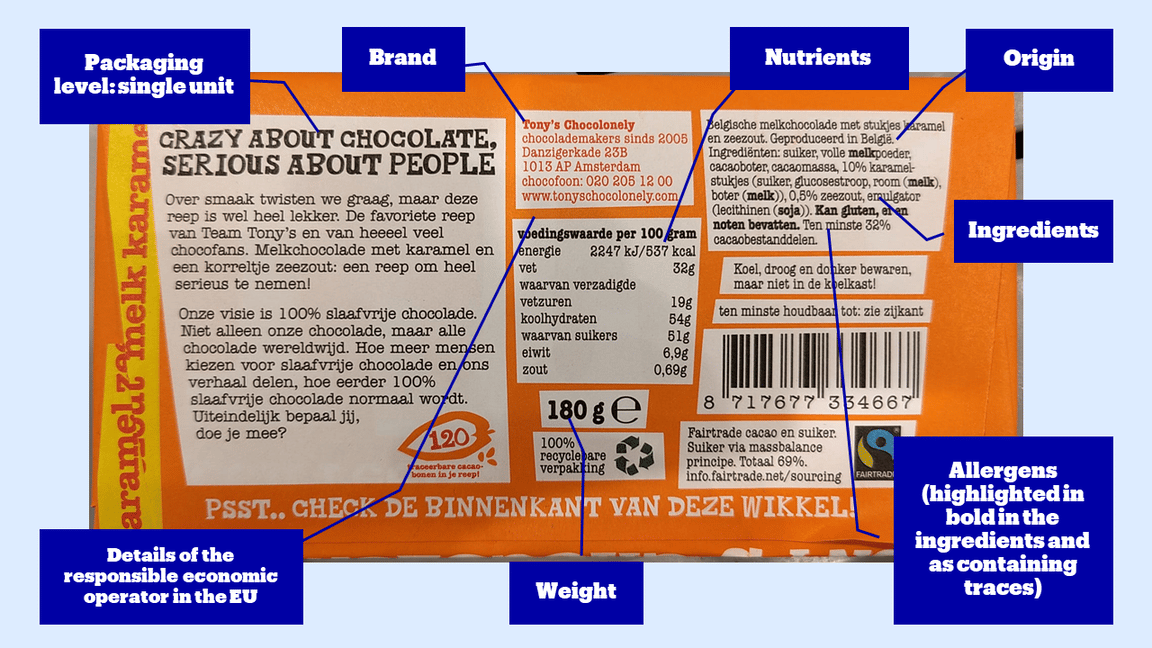
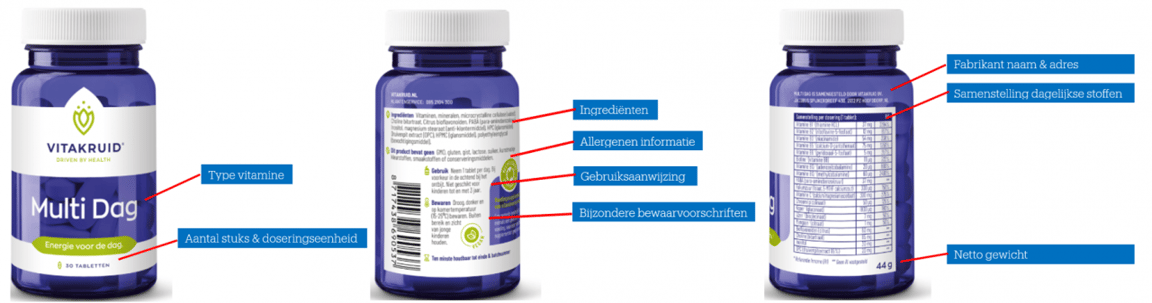
bol retrieves mandatory content (when available) from GS1 data or (when available) once from previously entered content. If this content is not available, you must enter it yourself.
More information
You can find more information on the websites of the European Union, the NVWA (Netherlands) and the FAVV (Belgium).
Correct content
References such as 'see label' or '-', '/', '0', etc., are not allowed. If the mandatory content is not filled in correctly, we will have to take the item offline. Items will automatically come back online once the mandatory content has been filled in correctly.
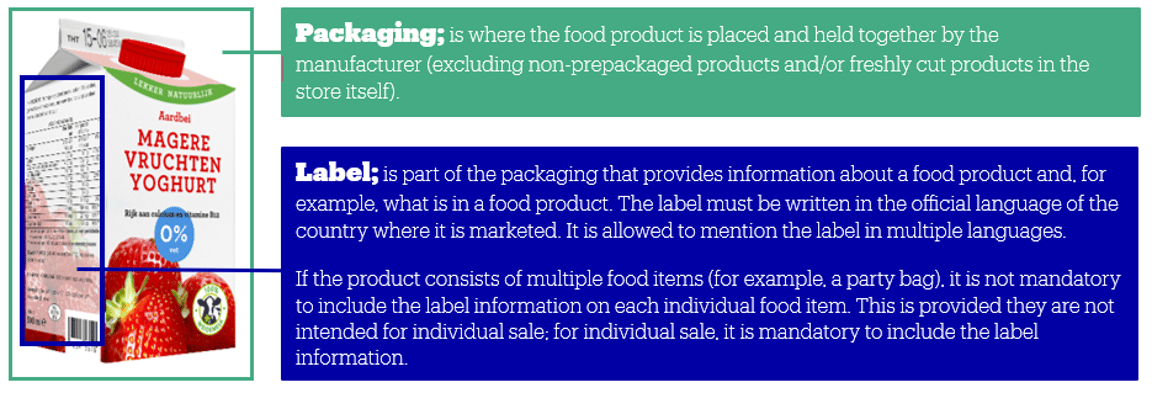
Packaging or label
Are you unsure about the difference between packaging and a label? We have added an example to clarify.
Correct content
References such as 'see label' or '-', '/', '0', etc., are not allowed. If the mandatory content is not filled in correctly, we will have to take the item offline. Items will automatically come back online once the mandatory content has been filled in correctly.
AZO Dyes
Manufacturers use dyes to create bright colors that make food (e.g., candy, cake) more appealing. There are several controversial dyes that are (sometimes) still present in food items and pose health risks. These substances can negatively affect children's activity and/or attentiveness. bol has therefore decided that from January 1, 2026, food and beverages containing AZO dyes E102, E104, E110, E122, E124, and E129 (see list below) will no longer be allowed. The sell-off period applies to the entire product range; enforcement will begin after January 1.
- E102 or Tartrazine
- E104 or Quinoline Yellow
- E110 or Sunset Yellow
- E122 or Carmoisine
- E124 or Ponceau
- E129 or Allura Red
Children's Idols on Food Items
Children's idols aimed at children up to 12 years old may not be used in advertising, packaging, and point-of-sale material (in-store promotions) on the bol platform. Children's idols are figures (including cartoon and/or animation characters) who are well-known from media specifically aimed at children, such as TV programs, films, online videos, blogs, comic books, books, and/or games. Well-known examples include:
- Paw Patrol
- Minions
- LOL Surprise!
- Peppa Pig
- Spongebob Squarepants
- Frozen
- Hello Kitty
- My Little Pony
- Looney Tunes
- Toy Story
CBD
Cannabidiol (CBD)
To sell items containing CBD (Cannabidiol) safely to our customers (and their pets), we have created additional guidelines. These guidelines apply in addition to existing laws and regulations. For CBD intended for human consumption, you are obliged to comply with the Food and Beverage policy.
CBD for human consumption
- CBD is a food supplement, a concentrated addition to normal nutrition, and is therefore only permitted in the product group for supplements.
- Food and beverages with added CBD are not allowed on our platform. See more information here about the Food and Beverage policy.
- Selling CBD supplements in Belgium? See more information here about selling food supplements in Belgium.
Additional conditions
- It is mandatory to give CBD items a GDSN GS1 registration, so it is clear that the items fall under the category of food supplements. Here you can find more information about GS1 registration in Belgium and the Netherlands.
- Active THC is not allowed, and it is mandatory to state how much THC an item contains. If you do not state this correctly, it will be considered food fraud.
- For the product characteristic ‘Type of herb or plant’, ‘CBD’ must be filled in. It is also mandatory to fill in a percentage for the product characteristic ‘THC content’.
- It is not allowed to make medical or health-related claims about an item. Check this carefully if you make a claim.
- The item may not contain an amount of active substances that would cause it to fall under medicines legislation. More information about this can be found here.
- PLEASE NOTE: for food supplements, strict requirements apply to labels on the packaging. These must be set up correctly with additional information about the name and conditions of use of the item.
CBD for animal consumption
For the safety of our customers' pets, it is important to adhere to the following conditions:
- Only approved hemp varieties may be present in CBD items for animals. See more information here about this legislation.
- It is mandatory to fill in all ingredients of the item in the designated product characteristic. These must match the actual content of the item.
Frozen Pet Food & Groceries
Offering groceries and pet food in a frozen state is a specialised branch within the food industry. Therefore, it is not permitted to offer frozen items via us without sales rights. Do you want to offer frozen items as a partner within the food and drink category? Then apply for sales rights here.
Pilot Phase
Currently, this product category is still in a pilot phase, and it is not possible to offer a frozen product range.
Dried animal items
For (perishable) foodstuffs such as cheese and sausage, legally prescribed temperatures have been established under the Commodities Act. This is enforced by the NVWA, which checks whether companies comply with the set criteria and the implemented food safety plan (HACCP or hygiene code). You can now sell dried animal items (such as cheese and sausage) via bol with selling rights. To do this, request selling rights via the following link.
The European Organic Label (SKAL)
To ensure that our customers receive controlled organic items, and that we comply with laws and regulations concerning organic items, we have set additional conditions for the use of the SKAL label.
What is SKAL and what does it mean for selling organic items?
What is SKAL and what does it mean for selling organic items?
SKAL is an independent administrative body that monitors the organic production process. It checks whether everything is processed, sold, and registered correctly.
Within the product categories of foodstuffs, food supplements, animal feed, plants, and flower bulbs, the term 'organic' is a protected term. It may only be used for controlled items. These items are recognizable by the European Organic Label, also known as 'the green leaf'. The Agriculture Biologique, Demeter, and EKO labels also meet SKAL's requirements. Therefore, these labels may also display the green leaf on the items. Every company that sells these items to our customers via our platform must register. bol may only offer and sell certified organic items. This means that both the intermediary and the producer must be certified.
For this certification, the items must comply with:
Please note!
It is your own responsibility to comply with the SKAL certification requirements.
What are the additional conditions for selling via our platform?
- Ensure that your company is SKAL certified to trade organic items
- Ensure that your storage of the items meets the SKAL storage requirements
- Request here the sustainability label 'European Organic Label', 'Agriculture Biologique', 'Demeter' or 'EKO' so that your organic product range is properly labeled on our website.
- The SKAL code NL-BIO-01 must be visible on the invoice to customers. To get the SKAL code on your invoice, it is important that the SKAL code (NL-BIO-01) is included in the title of the organic item. By placing the code in the title, the code will automatically appear on the invoice to the customer. We recommend placing the code at the end of the title.
Colloidal silver
Items containing colloidal silver are not suitable for consumption, as it carries significant health risks. For these items, explicitly state that they are “for external use only”. Adjust your instructions accordingly if needed. Strict enforcement will occur if incorrect instructions are provided.
Probiotics
The term ‘probiotics’ is a health claim and is therefore not permitted in the item description or product name for food items and supplements for consumers. The term 'biotics supplement' is permitted. Read here for more information on making claims and the conditions that apply.