
Computer & Electronics
Find all information regarding the assortment policy for the Computer & Electronics category here.
CE marking
We use CE & ECE markings to show that your items meet the safety, health, and environmental requirements. This marking is even required for most items sold in the European Union (EU). Read more about CE marking.
E-Waste/Stichting Open
Waste Electrical and Electronic Equipment (WEEE) Scheme / Stichting Open
Comply with legal regulations regarding electrical appliances
Are you a business owner who introduces appliances, lamps, or batteries to the Dutch market or sells them there? Then you may be subject to 'producer responsibility'. This is the case, for example, if you purchase items from outside the Dutch borders (intra-Community acquisition). If you fall under this scheme, you are legally obliged to collect and process these items safely and responsibly.
You don't have to manage this process alone. Register with Stichting OPEN, the Dutch organization that shapes this producer responsibility on behalf of importers and producers of appliances, batteries, and lamps. Stichting OPEN does this together with collection, sorting, recycling, and other chain partners. This is well-organized and good for the environment, because components, materials, and raw materials are preserved. These rules also apply to partners. Here they are summarized.
Rules for producers and importers: registration and reporting to Stichting OPEN
To find out if the rules related to producer responsibility apply to you, you must be able to answer 'yes' to at least one of the following questions:
- Do you produce electrical appliances in the Netherlands and place them on the Dutch market?
- Do you purchase electrical appliances abroad and place them on the Dutch market?
- Are you based abroad and do you sell electrical appliances directly to Dutch consumers?
It's good to know that almost all items that use electricity fall under the scheme, meaning all appliances with a plug or a place for a battery. If you are in doubt, consult Stichting OPEN.
Click here for more information and frequently asked questions about Stichting Open
Rules for retailers: Old-for-new scheme
In the Netherlands, electronics stores are obliged to take back old appliances when selling new ones (the 'old-for-new' scheme). If the customer buys an electrical appliance or energy-efficient lamp online, the retailer is also obliged to take back a similar item. (Web)stores are obliged to clearly offer the 'old-for-new' scheme to their customers before the payment process on the website is completed.
Important!
Do you sell (electronic and/or electrical) items with components that cannot be removed by the customer, also known as eWaste? Then it is mandatory to fill in 'yes' for the 'eWaste' product characteristic in the content of these items.
Amazon
To prevent confusion for our customers, it is not permitted to sell own-brand items from other online shopping platforms. For example, items from the brand or AmazonBasics.
Rejected items
bol highly values your safety and health. That's why we always carefully review items that could pose risks, even if there isn't yet any specific legislation or regulations. If an item is potentially harmful, it will be placed on the Safety Gate list. You are then not allowed to sell these items via bol.
Symbol for separate collection
All electrical and electronic items must display the symbol for separate collection: a crossed-out wheeled bin. This symbol indicates that the items do not belong with general waste. If this marking is not possible due to the size or function of the item, the symbol may also be placed on the packaging, user manual, or warranty certificate. More information about this symbol and its appearance can be found here: National (W)EEE Register.
Plug Connections
Together, we offer our customers in the Netherlands and Belgium a wide range of items. Our goal is that these items can be used by our customers without any issues. That's why we do not sell appliances without a Dutch or Belgian plug. We also do not sell appliances that have a travel adapter. A travel adapter is an attachment that makes a plug suitable for a Belgian or Dutch socket.
Product description
The Electronics category often includes complex items where the user needs extra explanation for installation or use. Therefore, make sure you help the customer with a good item description, and don't just repeat the item title.
Home Copy Fee
Do you sell storage items like smartphones, DVDs, USB sticks, or external hard drives? Then, as a partner, you must pay a home copy fee. This fee is for artists and authors who lose income because their work is copied by customers onto these devices.
- Are you selling in the Netherlands? Go to Stichting de Thuiskopie
- Are you selling in Belgium? Go to Auvibel
Walkie-talkies
The following conditions apply to selling walkie-talkies:
Frequencies and Transmit Power:
Walkie-talkies must operate within the license-free frequency bands:
- 434.040 MHz to 434.790 MHz with a maximum transmit power of 10 mW e.r.p.
- 446.00 MHz to 446.200 MHz with a maximum transmit power of 500 mW e.r.p.
Manufacturer Obligations:
- Mention of Frequencies and Transmit Power: The manufacturer must explicitly state the frequencies and transmit power in the manual, so the user knows which rules apply to the device.
- Fixed Antenna: The walkie-talkie must have a fixed, non-removable antenna. This prevents users from replacing the antenna with a higher-gain antenna, which could lead to exceeding the legal power limits.
- CE Marking and Declaration of Conformity: The item must have a CE marking, indicating compliance with European regulations for safety, health, and environment. Additionally, a Declaration of Conformity must be available, in which the manufacturer confirms that the item complies with the relevant EU directives.
Manual:
A manual must be included, either in Dutch or English.
Keyboards
To prevent compatibility issues, it is not possible to offer AZERTY keyboards in the Netherlands.
However, it is possible to offer QWERTY keyboards in Belgium.
Gas connection for gas stoves and hobs
To protect the safety of our customers, we only offer gas stoves and hobs on our platform that are specifically made for use in the Netherlands or Belgium. This is important because gas stoves and hobs designed for a specific country can cause dangerous situations when used in a country for which they are not intended. Therefore, we limit our offer to models that meet the specific requirements of these two countries.
Right to updates
Customers have the right to updates for smart devices (such as phones, tablets, televisions, and laptops) and for digital content (such as e-books and software). The partner is responsible for this. By law, as a provider, you are obliged to inform your customer about the availability of these updates, and the installation instructions must also be clear. Therefore, ensure that the mandatory content (support with updates) is up-to-date and complete, and prevent items from being taken offline.
Mobile phones 2G network
As of December 1, 2024, the 2G network will be switched off by various providers. This means that mobile phones using 2G will no longer be supported. To make sure customers don't buy phones they can't use, we will remove 2G phones from our product range starting December 1, 2024. Therefore, it will no longer be allowed to offer these items.
What is EPR?
EPR stands for Extended Producer Responsibility. It is an environmental policy that holds producers, meaning the party that introduces a product to the market in the Netherlands and/or Belgium for the first time, responsible for the entire lifecycle of their products, including the waste phase. This may also apply to you as a partner if you are the first to place products on the market. Read more about UPV on this page.
Universele opladers
On 28 December 2024, the EU introduced new legislation (Directive (EU) 2022/2380) for standardising chargers and charging specifications of electronic devices.
Read more about this legislation.
For certain items, it’s mandatory to specify whether the item is delivered with or without a charger and what the charging specifications for the device are. It concerns the following information:
- The minimum power the device requires to be charged.
- The maximum power the device requires to achieve maximum charging speed.
- Whether the device supports fast charging.
You can find this information in the manual, the technical data sheets, or on the manufacturer’s website.
You provide this information with your offer. For new items in certain categories, it’s mandatory to provide this information. After filling it in, the information is visible in the form of pictograms on the product page. It concerns the following attributes:
- Including adapter(s)
- Maximum power to charge
- Minimum power to charge
- Fast-charging functionality
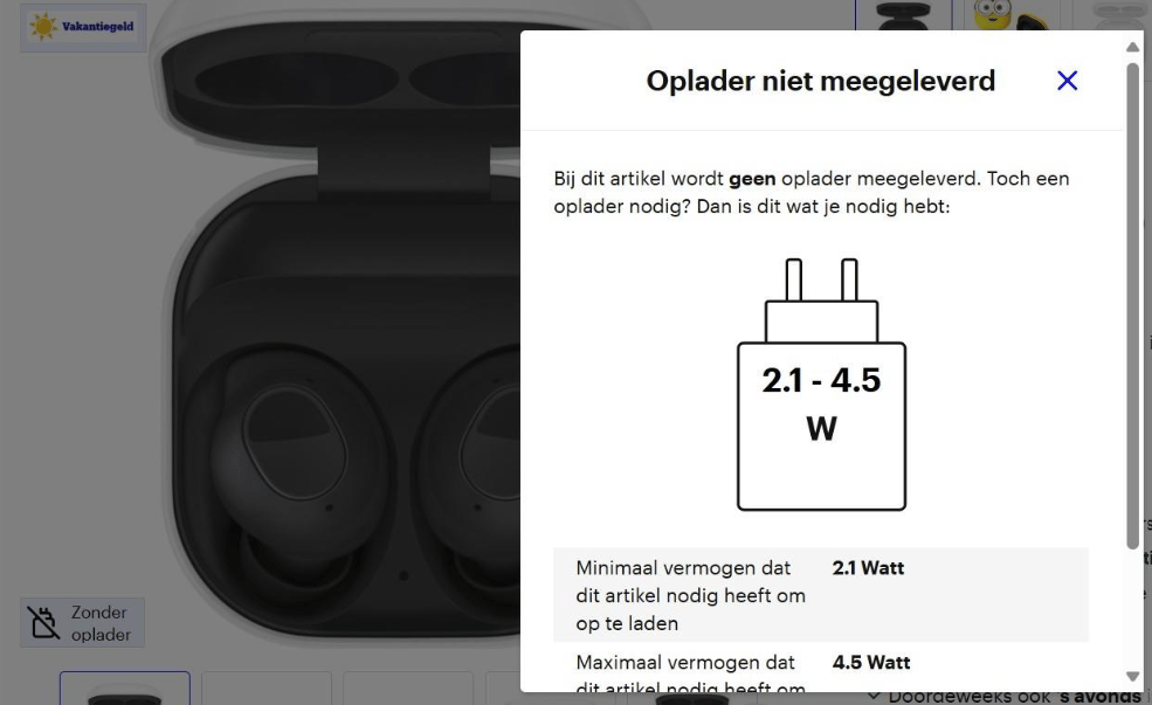
It concerns the following items:
- Mobile telephones
- Tablets
- Digital cameras
- Headphones
- Portable speakers
- Portable navigation systems
- In-ear headphones
- Headsets
- Portable videogame consoles
- e-readers
- Keyboards
- Computer mice
- Laptops
Additional obligation
The law requires consumers to have the option of purchasing an item without a charger. If you sell an item with a charger, you are legally required to offer it without 1 as well. This reduces electronic waste and customers have more to choose from. Win-win!