
Assortment and sustainability policy
We work hard every day to improve bol. We like to help customers make well-informed choices when they shop with us. This means we try to explain the benefits and positive characteristics of items clearly. We also give these items extra visibility through our Good Choice label. A good policy is therefore crucial. On this page, you can read everything you need to know about our sustainability and assortment policy.
Plastic
When necessary, bol anticipates legislation. We do this especially when it's clear that items in production or use are harmful to customer health and/or safety. Within the European Union, there is a ban on the sale of disposable plastic items, also known as single-use plastic. On the European Commission website, you can find an overview of the items that are prohibited from being placed on the market. This ban is gradually expanding, so the list below may not be complete. Therefore, consult the European Commission website or the Dutch/Belgian government for current regulations.
Mandatory SUP contribution
Since 2023, a waste contribution (SUP contribution) also applies to so-called point-of-sale packaging. This refers to the sale of empty food containers or cups. The party that places these items on the market is obliged to pay the SUP contribution for them. It is therefore possible that you also have to pay this SUP contribution. For rates and information in the Netherlands, see the Verpact website. For Belgium, more information is available on the Fost Plus website.
Illegal items
The following disposable plastic items are not legally permitted and therefore may not be sold via bol:
- Plates, cutlery, stirrers
- Straws
- Cotton buds
- Balloon sticks
- Drink and food packaging made of so-called expanded and extruded polystyrene (EPS and XPS)
- Items made of oxo-degradable plastic (e.g., bags and bottles)
Disposable items containing plastic
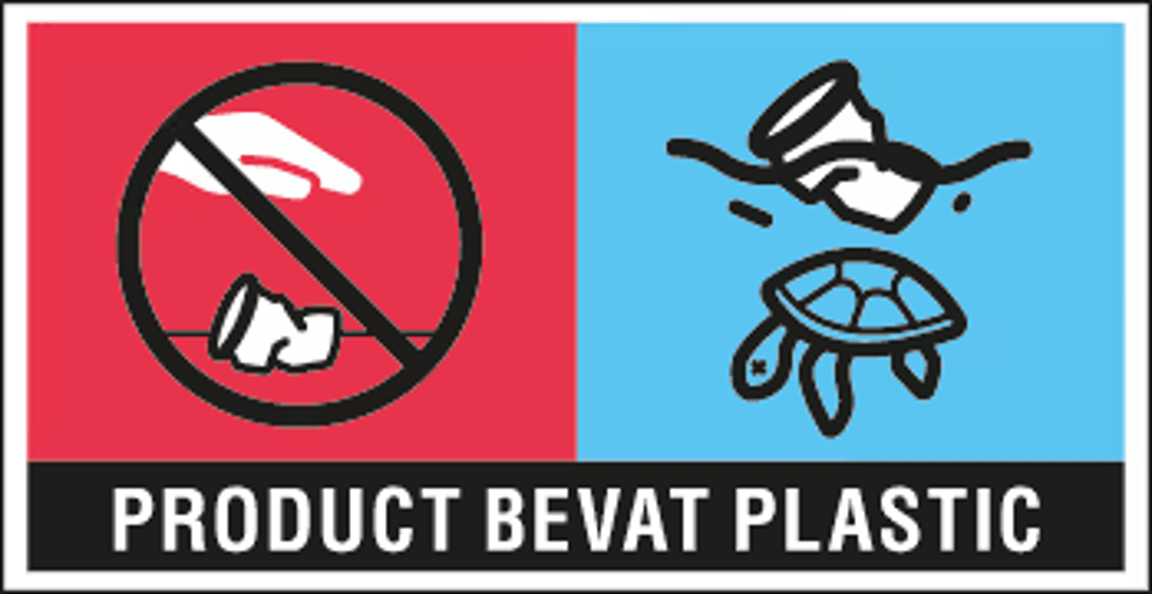
Disposable items made of plastic or containing plastic have the logo below. This includes items such as: wet wipes, tampons, sanitary pads, tobacco items, and drinking cups (for example, a paper cup/plate with a plastic layer).
Spatplastic
Additionally, as a platform, we want to take our responsibility and help combat plastic litter. That's why, on October 9, 2021, we signed the Spatplastic Covenant. Spatplastic refers to single-use plastic that spreads quickly. For example, when it's thrown or literally 'splashes' apart. This means that disposable water balloons and plastic confetti are prohibited on the platform. This policy also includes:
- Gift packages containing water balloons, plastic confetti, or balloon straws
- (Table) confetti, streamers
- Balloons with plastic confetti inside
Legal warranty
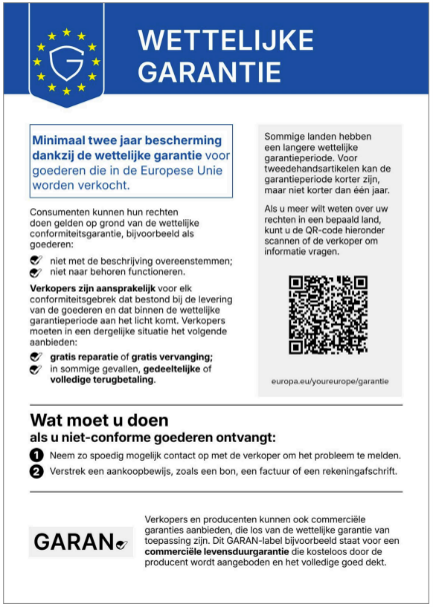
Customers are entitled to an item that does what it promises. In most European countries, the warranty period is at least two years. Some product categories are not covered by this legal warranty. This includes food, drinks, and single-use items. From July 22, 2026, we will display a clear notification for other items. This way, customers know exactly what their rights are when they order via bol.
Deviation from Dutch law
Dutch law deviates from the standard two-year warranty period within the European Union. Dutch law does not have a fixed two-year period but instead refers to the reasonably expected lifespan of the item. This period is therefore not fixed and varies per item. When determining this period, the law considers the type of item, the price category, brand (reputation), and any statements made by the provider. The economic lifespan of, for example, a washing machine in the higher market segment can be up to 12 years. A customer can then claim the legal warranty if a washing machine breaks down within 12 years. According to the law, customers are already entitled to a warranty. With the new European EmpCo (Empowering Consumers for the Green Transition) directive, we will inform them even more clearly about this. We will therefore add the legal warranty label to your items. This helps customers make an informed choice. Bol automatically adds these labels to the relevant product pages. You don't have to do anything for this yourself.
Commercial warranty
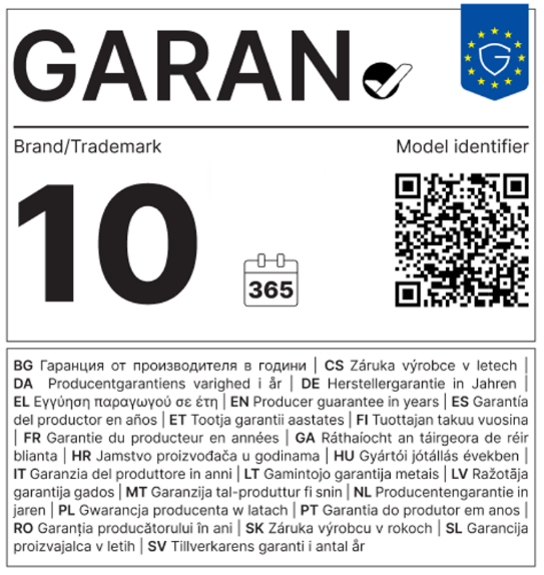
Customers are entitled to an item that does what it promises. In most European countries, the warranty period is at least 2 years. A commercial warranty is an additional warranty that a manufacturer or producer (or sometimes the seller) voluntarily offers, in addition to the existing legal warranty. If this applies to your item, you must display the GARAN label so that the customer can easily see how much commercial warranty is on the item. The GARAN label displayed with an item must show the number of years of commercial warranty in figures. This GARAN label is thus tailored to the specific item with which it is displayed. Displaying this label to the consumer is mandatory. Bol needs data for this, which you as a partner must provide to show the commercial warranty for an item.
Does this apply to your item? Then you must provide the GARAN label as shown in the example (format PDF, jpeg or png) as proof with your item. This can be added to the relevant item via your seller account.
For illustration, if the washing machine offered has a 10-year warranty from the manufacturer, this must be communicated to the customer via the GARAN label, on which the number 10 must be stated.
Please note: an item can only have 1 GARAN label. If you as a partner have a different commercial warranty, you must offer the item under a different EAN.
Additional content
In addition to the information a customer receives about the warranty, other information fields can be filled in so that they are visible to the customer.
- Other warranties: Any additional warranty services included with the item, for example, for specific use or only for a specific part of the item.
- Software updates: If applicable, the customer must be informed about how long the device will be supported with the latest updates.
- After-sales services: Any additional after-sales services included with the item.
- Repair score: The repair score indicates how easy your item can be repaired. If this is known for your item(s), you can enter that value here.
Repair conditions
For some product categories, spare parts must be available for a certain period (7 or 10 years) after the item is placed on the market to promote repair, starting from September. This obligation applies to manufacturers/producers and covers the following product categories:
- Mobile phones
- Washing machines
- Dishwashers
- Dryers
- Refrigerators
- TV screens
- Vacuum cleaners (excluding robot vacuum cleaners)
- Welding machines
- E-bikes
- Servers and storage items
For other product categories, it is currently not mandatory to have this available, but this may change in the future.
Microplastics
Microplastics are pieces of plastic smaller than 5 millimeters. These particles end up in the environment and accumulate there. They are not biodegradable but break down into increasingly smaller pieces. Microplastics are therefore very polluting to the environment and harmful to the health of humans and animals. Microplastics are present in various items, from cosmetics to synthetic clothing and from plastic bags to bottles. Many of these items end up as waste.
Glitter
In line with European legislation, the sale of microplastics in the form of loose glitter is prohibited as of May 1, 2024.
- Loose glitter, for example, where glue is supplied separately to attach it, is not permitted;
- Plastic granules such as plastic granulate or plastic pellets are a type of microplastic often used as a filler for items like plush toys or pillows.
Glitter that is already glued on or is part of an item – such as a glitter hat or glitter gel – may still be sold via the bol platform. Therefore, clearly state the following for your product range:
- what materials the glitter is made from;
- the size of the glitter
For biodegradable glitter, you must be able to provide proof through a product specification from the supplier and/or a declaration from the manufacturer that it is biodegradable.
Use of more sustainable terms
Claims, or statements, about the sustainability characteristics of items must be clear and relevant. Therefore, the content must comply with ACM guidelines. This means that vague terms should not be used in an item's description. Instead, you should specify concrete sustainability benefits, such as: 70% recycled material, waste-reducing, recyclable, or energy-saving.
Want to be sure your content is completely correct? Read here for more information about this policy or see here the full ACM guide for sustainability claims.
Fairtrade
Fairtrade is an unprotected term used to describe items that:
- are produced under good working conditions
- have fair trade agreements with farmers and employees
If an item you sell has a Fairtrade quality mark, we check if this aligns with its description. We do this based on the 4 quality marks below:
- Fairtrade
- World Fair Trade Organization
- Fair for Life (clothing)
If you sell an item with one of these quality marks, you can report it via this link. If this is correct, we can give you a Good Choice label. For items that claim to be Fairtrade but do not have a quality mark from one of these organizations, the claim will be removed from the content.
The European Organic Label (SKAL)
To ensure that our customers receive controlled organic items, and that we comply with laws and regulations concerning organic items, we have set additional conditions for the use of the SKAL label.
What is SKAL and what does it mean for selling organic items?
What is SKAL and what does it mean for selling organic items?
SKAL is an independent administrative body that monitors the organic production process. It checks whether everything is processed, sold, and registered correctly.
Within the product categories of foodstuffs, food supplements, animal feed, plants, and flower bulbs, the term 'organic' is a protected term. It may only be used for controlled items. These items are recognizable by the European Organic Label, also known as 'the green leaf'. The Agriculture Biologique, Demeter, and EKO labels also meet SKAL's requirements. Therefore, these labels may also display the green leaf on the items. Every company that sells these items to our customers via our platform must register. bol may only offer and sell certified organic items. This means that both the intermediary and the producer must be certified.
For this certification, the items must comply with:
Please note!
It is your own responsibility to comply with the SKAL certification requirements.
What are the additional conditions for selling via our platform?
- Ensure that your company is SKAL certified to trade organic items
- Ensure that your storage of the items meets the SKAL storage requirements
- Request here the sustainability label 'European Organic Label', 'Agriculture Biologique', 'Demeter' or 'EKO' so that your organic product range is properly labeled on our website.
- The SKAL code NL-BIO-01 must be visible on the invoice to customers. To get the SKAL code on your invoice, it is important that the SKAL code (NL-BIO-01) is included in the title of the organic item. By placing the code in the title, the code will automatically appear on the invoice to the customer. We recommend placing the code at the end of the title.
What is EPR?
EPR stands for Extended Producer Responsibility. It is an environmental policy that holds producers, meaning the party that introduces a product to the market in the Netherlands and/or Belgium for the first time, responsible for the entire lifecycle of their products, including the waste phase. This may also apply to you as a partner if you are the first to place products on the market. Read more about UPV on this page.
Extended Producer Responsibility Textiles (EPR Textiles)
Do you sell (business) clothing, table, bed, and/or household linen in the Netherlands? If so, since July 1, 2023, you are required to comply with the EPR Textiles Decree. This Decree makes you, as a producer/importer, responsible for the waste phase of clothing and household textiles. The government aims to encourage businesses to use textile waste for reuse and recycling. The EPR Textiles Decree holds producers and importers individually responsible for:
- the organization of a suitable separate collection system and the associated costs.
- recycling and reuse of the collected textiles.
What does this mean for you?
The EPR Textiles Decree applies to producers and importers who sell consumer and business clothing, table, bed, and household linen in the Netherlands. This applies to both Dutch and international partners, as well as to textiles made from recycled material. If you are a producer and/or importer of clothing and textiles, you officially have an individual responsibility to comply with the Decree. You may have this carried out by a collective/producer organization, such as Stichting UPV. You do not need to inform us how you comply with this decree. More information can be found on the website of Stichting UPV.