
Living
Find all information here regarding assortment policy for the Living category.
CE marking
We use CE & ECE markings to show that your items meet the safety, health, and environmental requirements. This marking is even required for most items sold in the European Union (EU). Read more about CE marking.
Fairtrade
Fairtrade is an unprotected term used to describe items that:
- are produced under good working conditions
- have fair trade agreements with farmers and workers
If an item you sell has a Fairtrade quality mark, we check whether this aligns with the corresponding description. We do this based on the 4 quality marks below:
- Fairtrade
- World Fair Trade Organization
- Fair for Life (clothing)
If you sell an item that has one of these quality marks, you can report this via this link. If correct, we can grant you a Goede Keuze label. For items that claim to be Fairtrade but do not have a quality mark from one of these organisations, the claim will be removed from the content.
Tobacco & Drugs
bol chooses not to encourage the use of tobacco or soft and hard drugs, making it prohibited to sell the following items via bol:
- Tobacco and other smoking items that fall under the Tobacco and Smoking Products Act. Furthermore, bol goes beyond the law and it is also not permitted to sell cigarette makers or accessories with aroma, such as aroma cards, aroma filters, aroma rolling papers, and aroma liquids.
- Items that fall under the Opium Act.
- E-cigarettes, vaporizers, and all other items that can be used for the consumption of nicotine (or a nicotine-free substance), which create vapor via a mouthpiece. Parts and accessories for these items, including refills, cartridges, tanks, and kits, are also not permitted to be sold via bol.
- Pipes, water pipes, weed pipes, and bongs. Parts and accessories for these items are also not permitted to be sold via bol.
- Items that can be associated with the production and consumption of soft and hard drugs. These include (electric) grinders, joint sleeves & –rollers, rolling trays & boxes, and cannabis seeds.
- Whipped cream chargers.
The following items are allowed:
- Ashtrays
- Lighters
- CBD products, as long as they comply with the applicable laws and regulations in the Netherlands and Belgium
The following items are allowed, as long as they are not related to cannabis
- Electric herb grinders
- Cigarette & cigar boxes
It is forbidden to sell rolling papers and tips, because bol does not want to encourage the use of tobacco or soft and hard drugs. It is also not permitted to show photos of cigarettes or cigars with smoking accessories.
Plant-based materials
We do not offer items via our platform that are made from plant species threatened with extinction. These species are listed on the CITES and/or IUCN lists. If you have items that are partly or fully made from protected plants, you are not allowed to offer them via bol. This applies even if you have a valid permit, declaration, or license for them. For example, the following materials are not permitted:
- Red coral (blood coral)
- Rosewood
Discover protected plant species with the CITES checklist (English & French)
Fire safety
Fire Extinguishers
All fire extinguishers you sell via bol must comply with the applicable laws and regulations in the Netherlands and Belgium. For selling items on our Dutch platform, the Portable Fire Extinguishers Decree applies. This concerns all items intended to fight fires through simple actions and with a filling in the device that does not exceed 20 kg in total. This rule applies to all fire extinguishers up to 20 kg intended for easily extinguishing fires.
No matter how small the fire extinguisher is, it must comply with this decree. Things you need to consider when selling a fire extinguisher:
- CE Mark
Ensure that the fire extinguisher has a valid CE mark. A valid CE mark demonstrates that the fire extinguisher complies with European regulations.
- Colour
The colour of the fire extinguisher must be red (RAL 3000).
- Certification valid for 5 years
All fire extinguishers must be certified before they can be sold on the Dutch and Belgian market. This certification is valid for 5 years. After this period, the certification of the fire extinguisher and the number on the device expire. No more devices may then be imported or sold under this number.
Safety Detectors (smoke, carbon monoxide, heat, gas, and combination detectors)
To protect the quality and safety of our product range, it is important that all safety detectors (smoke, carbon monoxide, heat, gas, and combination detectors) comply with European laws and regulations.
Therefore, via bol, you can only sell safety detectors that:
- comply with the relevant European safety standards. It is important that this is also entered under ‘Type standard’ in the content;
- have a Dutch manual that complies with European safety standards, both physically and digitally; and
- have been tested by a Notified Body (NB) in Europe.
Specific requirements that a CO detector (carbon monoxide detector) must always meet are:
- The name of the manufacturer, supplier, or brand
- The name of the CO detector and model number
- Type of gas to be detected
- The lifespan of the detector
- The text: ‘Read the instructions’ in Dutch
In addition, the included Dutch manual must contain explanations about, among other things:
- Placement and installation
- The expected lifespan
- The test procedure
Safety requirements for boilers and geysers
Boilers and geysers are items with a high safety risk due to the dangers associated with gas, pressure, electricity, and carbon monoxide. Therefore, additional requirements apply when you offer these items via bol.
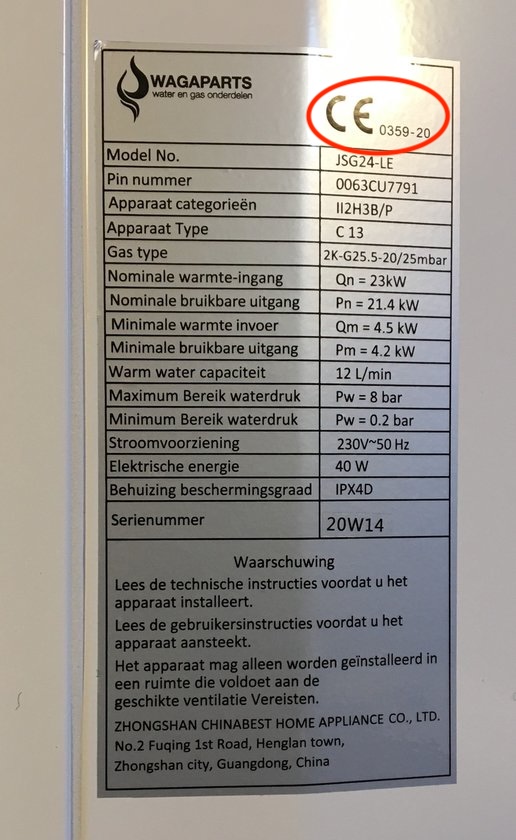
For each boiler or geyser, upload a clear and legible photo of the type plate and the CE marking. Add this to the content as an image. The type plate must be in Dutch.
For gas boilers and gas geysers, 2 additional requirements apply:
- The Notified Body (the 4-digit identification number) must be clearly visible as an addition to the CE marking. Also, add a photo of this to the content under the CE section. On the type plate, this is often stated as a series of 6 characters (e.g., 0359-20). The code is structured as follows:
The first 4 digits form the official identification number of the inspection body (e.g., 0359).
The last 2 digits indicate the year of manufacture (e.g., -20 for 2020).
Ensure that this complete combination of numbers is sharp and clearly legible next to or below the CE logo in the photo.
- You must be able to provide a valid GAR certificate upon request from bol.
Wood stoves
From 2022, the EcoDesign legislation applies to wood stoves. This legislation was created to reduce the environmental impact of wood stoves. The following requirements now apply to wood stoves. It is not permitted to offer wood stoves that do not meet these requirements:
- Efficiency
Wood stoves must have a minimum efficiency percentage of 75%. This means that 75% of the burned wood is converted into heat used to warm a room. The other 25% is lost as smoke.
- Emissions
Wood stoves may emit a maximum of the following amounts:
- Particulate matter: 40 mg/m³ (at 13% O₂)
- Carbon monoxide (CO): 1,500 mg/m³ (at 13% O₂)
- Organic gaseous compounds (OGC): 120 mg/m³ (at 13% O₂)
- Nitrogen oxides (NOx): 200 mg/m³ (at 13% O₂) - In addition, all wood stoves must comply with the CE marking requirements and have a declaration of conformity. The manufacturer is responsible for having the stove tested by an official body. Furthermore, every stove must have an energy label according to the Energy Labelling legislation.
Keys, Lockpicks & Odometers
We do not want to offer items that could negatively affect users or their environment. Therefore, we do not sell items that are almost exclusively used for criminal purposes. So, you may not offer items that are strongly associated with burglary or fraud, such as:
- Key duplicators
- Odometer rollback devices
- Cylinder pullers
- Lockpick guns*
- Seatbelt clips to stop the alarm
*In contrast to lockpick guns, lockpick sets are allowed due to their hobbyist nature and the minimal force used.
Second-hand
Second-hand items or margin items can only be offered in the categories books, music, games, and movies. For other categories, you cannot request selling rights. Therefore, it is not possible to offer second-hand items other than books, music, games, and movies via bol.
CLP Safety Warnings
Safety information is provided on the packaging of some items. This information is important because it ensures our customers receive items of high quality and safety. Additionally, European guidelines require you to include this safety information on the item page. More information about these regulations can be found here. The mandatory safety information can be found on the item's packaging. Detailed safety information is provided on the Safety Data Sheet (SDS). The SDS can be requested from the item's partner. SDS is important for product categories containing items with hazardous substances. Examples include items such as superglue, laundry detergent, and dish soap. For each item, fill in the required characteristics. These must be identical to the safety information on the item's packaging label:
- SIGNAL WORD: 'Danger' or 'Warning';
- HAZARD STATEMENT(S): on the label, these can be found under the heading 'hazard statements'. These are identifiable by the H-phrases on the SDS;
- PRECAUTIONARY STATEMENT(S): these are the recommended precautionary measures. These are identifiable by the P-phrases on the SDS.
Please note
All safety information selected for the attributes must exactly match the label on the item packaging. This way, we ensure together that our customers are informed about the safety risks of this product range.
New energy label guidelines 2021 for lighting
Effective September 1, 2021, the energy labeling rules within the European Union have changed. As most light sources become increasingly energy-efficient, more and more fall into classes A, A+, and A++. This has proven confusing for the customer. Therefore, this classification for lighting has been gradually phased out since 2021. The new classification only includes categories A through G (without A+ and A++).
What do I need to do?
To comply with the new legislation, you need to:
- fill in the item characteristic ‘Energy Label Value New 2021’.
- add the PDF of the new label to the item characteristic ‘Energy Label URL’.
- manually remove old energy labels uploaded as JPG files among the images.
To ensure that energy labels are only added to items where necessary, the following item characteristics must be filled in:
- the item characteristic ‘Light source included’. If no light source is supplied with the fixture, the supporting structure of 1 or more lamps, then no energy label needs to be linked.
- the item characteristic ‘Light source removable’. If the light source can be removed from the fixture without damaging it, then no energy label needs to be linked. If the light source is fixed in the fixture, an energy label must be linked.
- the item characteristic ‘Works on’. An energy label only needs to be added if a lamp works on mains power. For example, lamps that work on a battery or accumulator do not require an energy label.
End of Life (EOL) items
End-of-life items placed on the market before November 1, 2020, and therefore without a digital version of the new energy label, have no longer been permitted for selling via bol since March 1, 2023. We will take these items offline. The new energy label is mandatory for selling via bol.
Changes on the bol website
Using both old and new energy labels simultaneously creates confusion for customers. Old labels can unfairly compete with new labels because an old label might appear more energy-efficient at first glance. The content and test guidelines can also lead to confusion. Therefore, old energy labels may no longer be used in filters, content, and/or advertisements from bol as of September 1, 2021. If old energy labels are mentioned in the title or description, this must be adjusted. Old energy labels uploaded as a PDF in the ‘Energy Label URL’ attribute will be removed.
E-Waste/Stichting Open
Waste Electrical and Electronic Equipment (WEEE) Scheme / Stichting Open
Comply with legal regulations regarding electrical appliances
Are you a business owner who introduces appliances, lamps, or batteries to the Dutch market or sells them there? Then you may be subject to 'producer responsibility'. This is the case, for example, if you purchase items from outside the Dutch borders (intra-Community acquisition). If you fall under this scheme, you are legally obliged to collect and process these items safely and responsibly.
You don't have to manage this process alone. Register with Stichting OPEN, the Dutch organization that shapes this producer responsibility on behalf of importers and producers of appliances, batteries, and lamps. Stichting OPEN does this together with collection, sorting, recycling, and other chain partners. This is well-organized and good for the environment, because components, materials, and raw materials are preserved. These rules also apply to partners. Here they are summarized.
Rules for producers and importers: registration and reporting to Stichting OPEN
To find out if the rules related to producer responsibility apply to you, you must be able to answer 'yes' to at least one of the following questions:
- Do you produce electrical appliances in the Netherlands and place them on the Dutch market?
- Do you purchase electrical appliances abroad and place them on the Dutch market?
- Are you based abroad and do you sell electrical appliances directly to Dutch consumers?
It's good to know that almost all items that use electricity fall under the scheme, meaning all appliances with a plug or a place for a battery. If you are in doubt, consult Stichting OPEN.
Click here for more information and frequently asked questions about Stichting Open
Rules for retailers: Old-for-new scheme
In the Netherlands, electronics stores are obliged to take back old appliances when selling new ones (the 'old-for-new' scheme). If the customer buys an electrical appliance or energy-efficient lamp online, the retailer is also obliged to take back a similar item. (Web)stores are obliged to clearly offer the 'old-for-new' scheme to their customers before the payment process on the website is completed.
Important!
Do you sell (electronic and/or electrical) items with components that cannot be removed by the customer, also known as eWaste? Then it is mandatory to fill in 'yes' for the 'eWaste' product characteristic in the content of these items.
Extended Producer Responsibility Textiles (EPR Textiles)
Do you sell (business) clothing, table, bed, and/or household linen in the Netherlands? If so, since July 1, 2023, you are required to comply with the EPR Textiles Decree. This Decree makes you, as a producer/importer, responsible for the waste phase of clothing and household textiles. The government aims to encourage businesses to use textile waste for reuse and recycling. The EPR Textiles Decree holds producers and importers individually responsible for:
- the organization of a suitable separate collection system and the associated costs.
- recycling and reuse of the collected textiles.
What does this mean for you?
The EPR Textiles Decree applies to producers and importers who sell consumer and business clothing, table, bed, and household linen in the Netherlands. This applies to both Dutch and international partners, as well as to textiles made from recycled material. If you are a producer and/or importer of clothing and textiles, you officially have an individual responsibility to comply with the Decree. You may have this carried out by a collective/producer organization, such as Stichting UPV. You do not need to inform us how you comply with this decree. More information can be found on the website of Stichting UPV.
Which item categories fall under this policy?
What is EPR?
EPR stands for Extended Producer Responsibility. It is an environmental policy that holds producers, meaning the party that introduces a product to the market in the Netherlands and/or Belgium for the first time, responsible for the entire lifecycle of their products, including the waste phase. This may also apply to you as a partner if you are the first to place products on the market. Read more about UPV on this page.