
Selling in Belgium
You can easily expand your selling reach by also selling your product range in Belgium. On this page, you can read what is important to know when you want to sell via bol to Belgium.
Selling in Belgium
By also selling via bol in Belgium, you reach over a million extra customers every day. If you want to sell via bol in Belgium from the Netherlands, there are a few things to keep in mind:
Shipping
Carriers do not distinguish between Dutch-speaking and French-speaking Belgium. Choose a shipping partner who can help you meet your delivery promise in Belgium. Timely delivery is very important for customer satisfaction, and the delivery options offered by postal companies may differ for cross-border shipments.
Unlike in the Netherlands, for selling via bol in Belgium:
- a letterbox parcel is not larger than 35 x 23 x 3 centimeters
- bol offers affordable shipping labels from bpost and DPD
- the prices of the return labels for the bol return service differ per country
- for the product range you sell via Logistics via bol, your items are offered by default in both Belgium and the Netherlands. Except for XS items, the rates are the same for delivery in both countries. Do you prefer to offer your items via Logistics via bol in a specific country? Then choose between the Netherlands and Belgium and indicate this choice in your seller account; go to 'Settings' and click 'Across the border' under 'My shop'.
Important!
Experience shows that delivery in French-speaking Belgium is more prone to delays. We therefore advise you to closely monitor whether your stated delivery time is realistic. As a partner, you remain responsible for meeting the delivery time you indicate.
Tip!
For packages sent abroad, shipping costs may be higher. Do you want to pass this on in your selling prices? It is then advisable to create a separate seller account for your orders from Belgium.
Delivery and pick-up appointments for French-speaking customers
Do you sell product range in French-speaking Belgium that falls within the Large & Heavy category (such as dishwashers, refrigerators, washing machines)? You or your logistics partner will need to make a delivery appointment with these customers in French to be made. Both within the API and in the seller account, you can find the language of the order for each order. Therefore, make sure that for these French-speaking orders, you send your communication in French.
To make it as easy as possible for you, various French sample emails have been prepared to make a delivery and/or pick-up appointment; you can find them here.
If you use a logistics partner for delivery and appointments, also check carefully if and how you pass on the language of the order and arrange this with your logistics partner. Of course, you can also share the templates on our platform with them!
Below is more information on where language information can be found within the API and seller account.
API
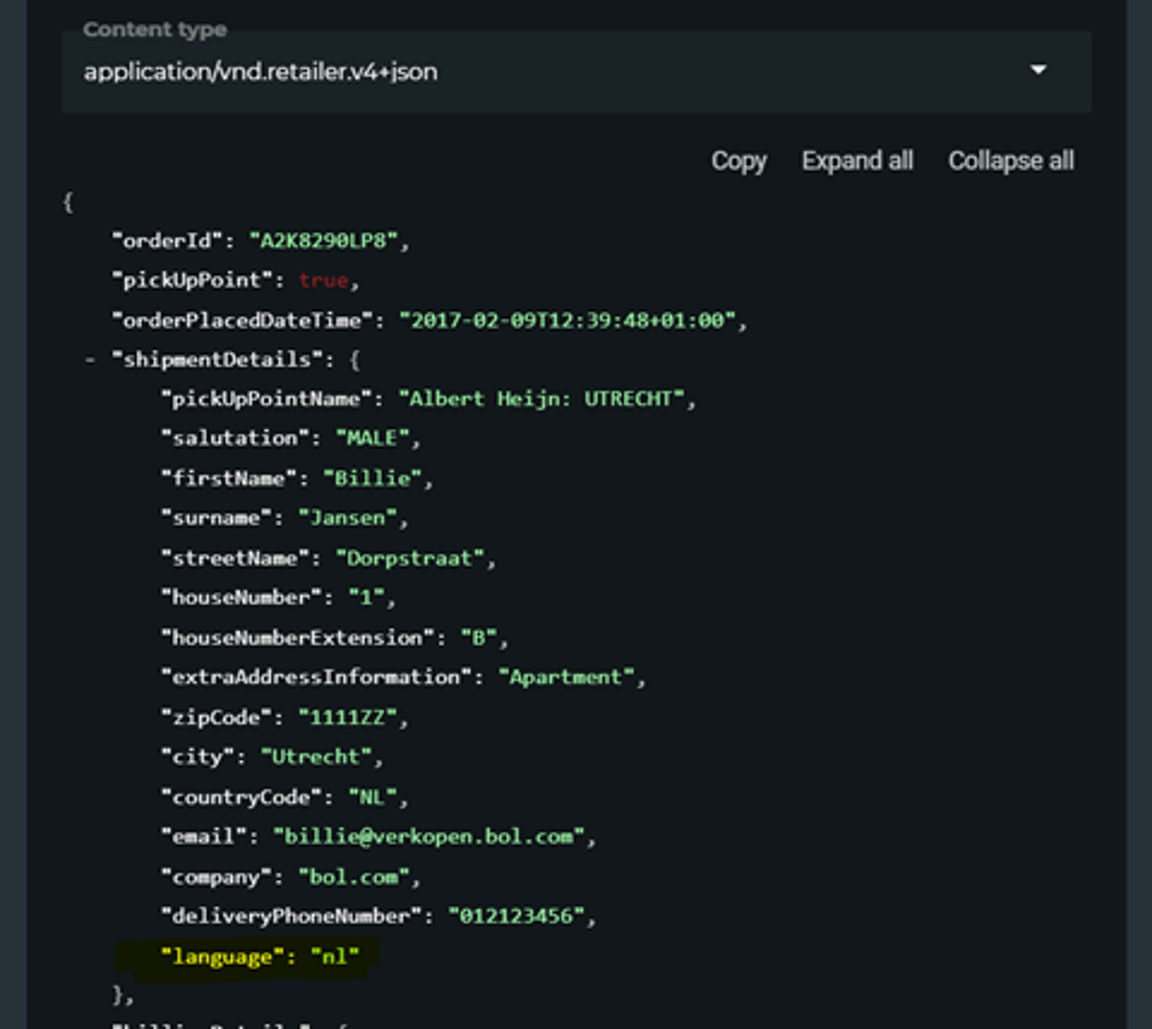
You can find language information in the API by clicking on the following links: ‘get an open order by order id‘ or ‘get shipment by shipment id‘. “Language” shows the customer's language, where “fr” and “fr-BE” refer to French, and “nl” and “nl-BE” refer to Dutch. See example below:
Seller account
You can find the language information in the Seller account on the open orders tab. For each order, you will find “Customer Language”. Below, you will see the customer's language and a language flag. See example below:

Packing slip
When shipping, make sure you do not include a Dutch packing slip for French-speaking customers. In your seller account, you can see which language your customers speak. This is located under the 'Orders' tab in the order information.
Via the API, you can see your customers' language using the 'get an open order by order id' or 'get shipment by shipment id' option.
The packing slip and order information also show the order with the French title. Keep this in mind when picking your orders. This can be more difficult if you are not proficient in French. Alternatively, you can choose to pick your orders using the EAN number or the reference.
Return address
It is not possible to use a Dutch PO box or reply number for returns originating from Belgium. Returning to a regular Dutch address is possible.
Unfortunately, it is not yet possible in the French-language app to display additional return conditions, self-composed return instructions, packaging instructions, and pick-up instructions.
We forward return questions to the French-speaking customer service, who will translate your conditions and instructions. If you have provided instructions to contact us by email, you might receive a French-language email. If the service employee and the customer cannot resolve the issue, we will contact you. We are working on a solution to make additional return conditions visible.
Legislation regarding product range
The most important rules for online shops belong to European Regulations and are therefore the same for the Netherlands and Belgium. However, there are exceptions.
Within certain product categories, legislation and regulations can differ. For example, the legislation regarding selling via bol in the 'Beauty & Health' product category in Belgium is different; the FAGG (Federal Agency for Medicines and Health Products) strictly supervises what can and cannot be sold online here. Therefore, most items in this category are excluded from selling via bol in Belgium.
Are you unsure whether your product range is suitable for selling via bol in Belgium? You can find more information on the page ‘Suitable and unsuitable offers’.
Tip!
Do you sell in both countries and have a product range that can only be sold in the Netherlands? By creating a separate seller account for your orders from Belgium, you can continue to offer these items via bol in the Netherlands.
Flemish and French content
We understand all too well that language can be a barrier to growing in Belgium. There are some clear differences between the Flemish and Dutch languages, and thus also in how you provide content about your items. For example, in Belgium, microwaves are called 'microgolfovens'.
Items eligible for selling via bol in French-speaking Belgium are automatically translated from Dutch to French.
Flemish content
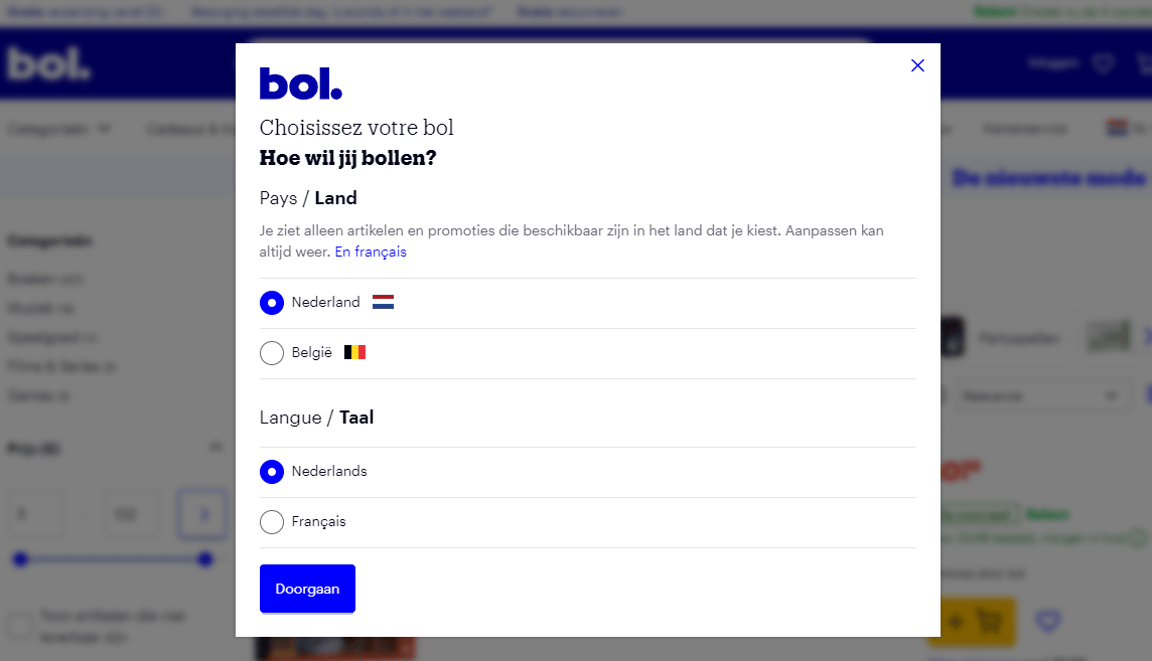
Curious about the differences between both languages? To get an idea, you can choose the Belgian version of the website on the top right of the shopping platform.
French content
We understand all too well that language can be a barrier to growing in French-speaking Belgium. That is why we ensure that all items eligible for selling via bol in French-speaking Belgium are automatically translated from Dutch to French. For now, this also applies to new product range. However, original (French-language) item titles and descriptions are often of better quality. It is therefore advisable, where possible, to ensure high-quality translations in the content yourself. You can read how to do that here.
Do you sell Large & Heavy items in Dutch-speaking Belgium? Almost the entire Large & Heavy product range from partners selling via bol in Dutch-speaking Belgium is automatically put online in the French-language app. Whether an item is actually offered in the French-language app depends on the language of the item, manual, and/or packaging. This prevents Dutch-language items (for example, the Dutch Monopoly) from being offered in French-speaking Belgium. By correctly filling in these attributes, you ensure that the items are translated and discoverable in French-speaking Belgium (this sometimes takes a few days).
VAT and distance selling
Are you selling via bol from the Netherlands to customers in Belgium? Then carefully check whether there are Belgian tax obligations for your company, such as Belgian VAT or excise duty obligations.
For example, certain cross-border deliveries are considered distance selling – and VAT may be involved. Something is distance selling if an item:
- is delivered to Belgian customers who do not file a VAT return and
- is transported directly or indirectly, by you or on your behalf, from the Netherlands to Belgium.
Distance selling has a threshold amount. As soon as your total turnover to customers without a valid VAT number in other European Union (EU) countries exceeds this threshold, you are obliged to calculate the local VAT rates on this. These are the rates of the country where you deliver the goods. Since July 1, 2021, the threshold amount for selling via bol in other EU countries is 10,000 euros, excluding VAT. So there is one threshold amount for all EU countries combined.
This threshold amount does not only apply to your distance selling via bol; it applies to all distance selling and digital services from your company and thus also to any selling via other channels. So, you add sales via, for example, your own webshop or another platform to this.
Have you exceeded the threshold amount in a certain year? Then this threshold no longer applies to you in the following year. In that year, you already have a VAT obligation directly from the first sale.
Please note: you must also report and pay the due foreign VAT in the customer's country. This can be done in 2 ways:
- By registering with the local tax authorities of the EU country where you deliver the goods and filing a VAT return there.
- By using the so-called One Stop Shop (OSS) scheme. With this scheme, you can declare and pay the VAT you owe in all other EU countries at one counter. The OSS scheme can only be used for distance selling.
Exceptions
There are also some exceptions. Special rules apply to the delivery of these goods:
- Excise goods (e.g., alcoholic beverages) – for deliveries to private individuals, you always owe VAT in the country of arrival of the shipment, regardless of the threshold.
- Goods falling under the margin scheme
- New and almost new means of transport
- Installation deliveries
Control and penalties
The Belgian government checks and penalizes entrepreneurs who have not paid the due VAT or excise duty, or not fully. This can be retroactively. It is therefore advisable to thoroughly investigate which tax rules apply to your company and to keep a close eye on any changes. Also, regularly check whether the threshold amount of 10,000 euros for distance selling and digital services applies to you and whether you are exceeding this threshold. This may mean that you need to make adjustments.
It is important that you fulfill all your tax obligations in Belgium on time. If the Belgian Tax Authorities inform us that you have not paid all your Belgian VAT, this may lead to the closure of your seller account. Read more about this in this news item.
Do you want more information about this? Then visit the website of the Dutch or Belgian tax authorities or the European Commission. Carefully review these rules or seek advice from your own (tax) advisor.
Intra-community supply
Cross-border selling to business parties is also known as intra-community supply. Different VAT rules apply to intra-community supplies of goods. You can read more about intra-community supplies for Dutch entrepreneurs here.
Invoice
When customers place an order with you, they automatically receive a payment overview from bol. In addition, for a cross-border sale, as a partner, you are obliged to send an invoice to the customer. For cross-border selling, this applies to sales to both business and private customers (distance selling).
The French-language app is currently only accessible to customers. However, it may happen that a customer still asks for a VAT invoice. Even for French-speaking customers, you are (at the customer's request) responsible for providing a VAT invoice. On the Partnerplatform, you will therefore find a ready-made example for a VAT invoice in French. You can find this example on this page.
Are you a Belgian partner and do you sell to Belgian business customers?
From 1 January 2026, new legislation will apply in Belgium. Belgian partners will need to issue B2B invoices via structured electronic invoicing A VAT invoice via our will no longer be accepted. Read more about it here.
Frequently asked questions
about French-speaking Belgium