
Substantiation sustainability feature Energy efficient
Substantiation of how the energy efficient sustainability feature is assigned
Methodology
The lower limit for the “30% most energy efficient” label is based on the most efficient 30% of sold appliances per product group. Kenniscentrum Duurzaam Leven - Milieu Centraal uses sales figures because this properly combines the ambition and capabilities of consumers with the offer.
The cutoff point of a maximum of 33% is based on Rogers' Innovation Adoption Curve (Rogers, 1962). In the case of Energy labels for appliances, Milieu Centraal bases this on the groups Innovators (2.5%), Early Adopters (13.5%), and half of the Early Majority (34%). This curve shows the distribution in the adoption rate of an innovation, distinguishing between groups of people based on the stage at which they adopt/buy the innovation. Bol has further tightened this cutoff point to 30% compared to the 33% from the model.
Appliances for which the label class is leading meet at least the following requirements:
- The climate impact through electricity consumption is an important hotspot in environmental burden.
- It is plausible that most of the environmental impact occurs in the usage phase (and not in the production or disposal phase).
- The choice of the appliance already implicitly incorporates what a suitable size is (e.g., by filtering on product size).
- The energy label in this product group is not a measure of absolute energy efficiency that only has value within a subtype of the product group (such as in the TV example).
Assignment
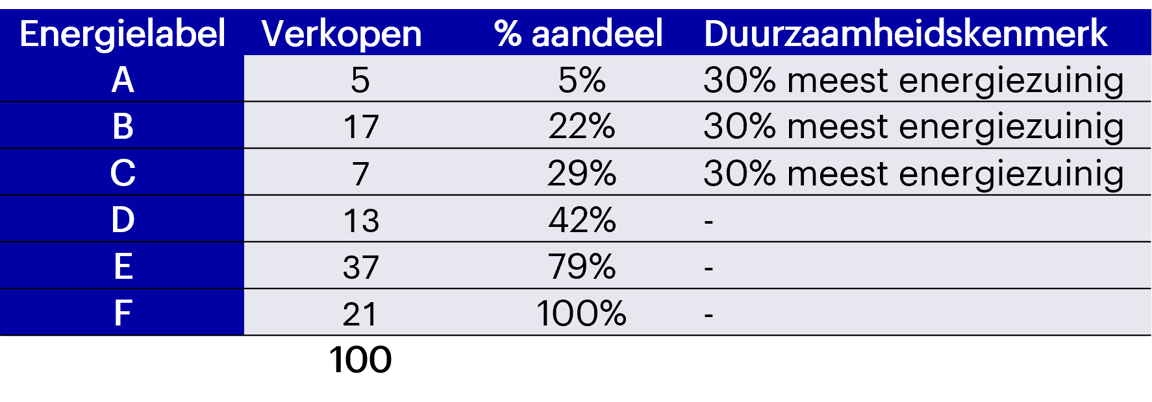
The items within a product category that belong to the most efficient 30% according to the methodology receive the sustainability feature “30% most energy efficient”. See example
Update
Appliances are becoming increasingly efficient. In addition, people's buying behaviour will shift as they buy new innovations. As the offer and sales of such appliances shift to better energy labels, the more sustainable spectrum of the label shifts along with it. The energy label cutoff point(s) are updated annually.
Items
The following product groups are currently offered on bol and have been included in Milieu Centraal's analysis to evaluate:
- Fridge freezer combination
- Tabletop fridge
- Larder fridge
- Built-in fridge freezer combination
- Built-in fridge
- Freezer
- Chest freezer
- Built-in freezer
- Freestanding dishwasher
- Built-in dishwasher
- Light source
When label class does not say enough about sustainability
There are appliances where the label class did not say anything about the relative sustainability, and thus the most energy-efficient choice for an appliance. Some examples of this are the washing machine and television.
For example: the energy label of a television tells you something about the energy consumption relative to televisions of the same size. A relatively efficient large 80-inch television can therefore have a better energy label than a relatively inefficient small 32-inch television, even though the energy consumption of the 80-inch television is much higher than that of the 32-inch television.
In such a situation, no generally applicable guidelines can be given on which appliance-energy label combinations qualify for the sustainability feature. These categories will therefore not be assigned a sustainability feature.