
ACoS: advertising costs per sale
For an automatic campaign, you need to set your ACoS. ACoS stands for Advertising Cost of Sale. In other words: the percentage of your revenue you spend on sponsored products. How do you calculate it and use it to your advantage? We're happy to explain.
Calculate your ACoS
You calculate your ACoS by dividing the total amount you spent on advertising by the revenue you earned from it.
If you spent €10 on ads and earned €100 in revenue, your ACoS is 10%.
Example
Imagine you sell books for €27 each. You pay €5.67 in VAT on this. So, we'll calculate with a selling price of €21.33.
You buy the book for €6, ship it for €8, and pay €2 in commission. When you subtract all costs from the selling price, €5.33 remains. This is the profit you make per book without advertising. This means you can spend up to €5.33 on ads without losing money on the item.
To calculate your ACoS, simply divide the amount you have available for advertising costs by the selling price (€5.33/€21.33 = 0.24). This results in an ACoS of 24%.
What is a good ACoS?
When you start advertising, it's good to consider what your ideal ACoS is. What makes a good ACoS depends on your goal:
- More visibility? Do you want as many people as possible to see your brand or item? Then you focus on impressions. In this case, a higher ACoS is fine, because you're investing in brand awareness, not directly in profit.
- More conversions? Do you mainly want to sell? Then you drive clicks and want to keep your ACoS low. A lower ACoS means your ads are profitable and convert well into sales.
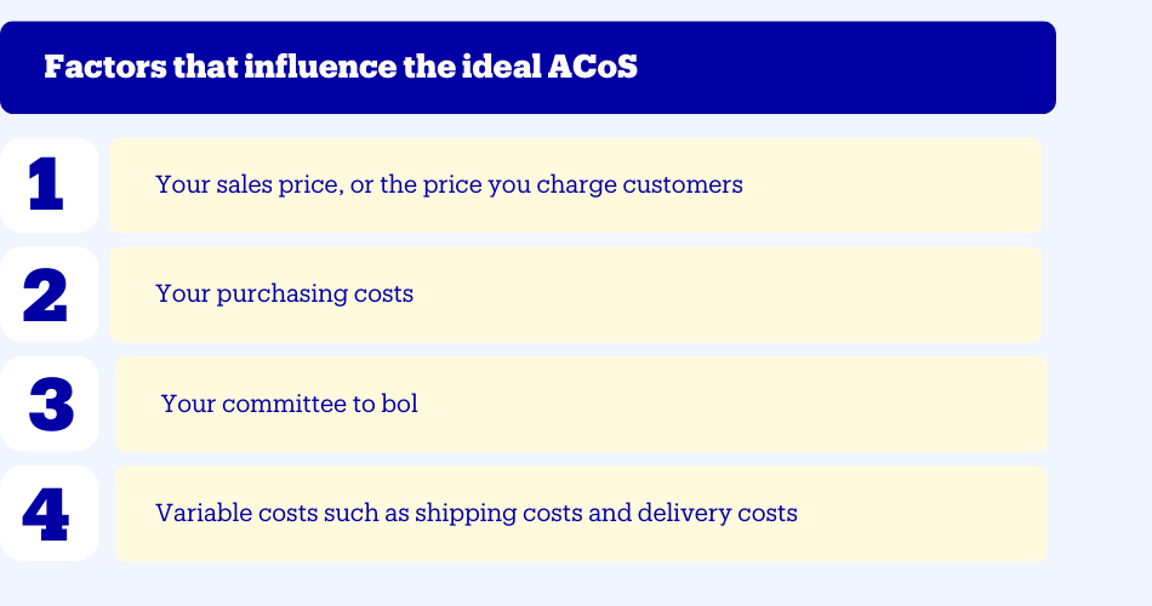
Besides advertising costs, the following factors are also part of this calculation:
Tip from our expert
“See ACoS as an investment and consider what your margins allow.” - Pauline, Campaign Specialist
Change in ACoS
A change in your ACoS can be an effect of campaign improvements, such as adjusting your CPC (your bid in the auction), adding or excluding placements, or pausing or activating items within your campaign. But it can also be a result of changes in, for example, click prices (CPC), conversion rates, and click-through rate (CTR).
Because: more conversions and lower CPCs often lead to a lower ACoS.
- The higher your CTR, the more visits, the cheaper your CPC
- The higher your conversion rate, the more sales from the same number of clicks.
4 causes of a poor ACoS
Are your advertising costs eating into your profit? Then your ACoS is not ideal. There can be several causes of a poor ACoS:
- Competition in your product category is high
- Bidding prices for your keywords are high
- Your delivery time is longer than that of the competition
- The item doesn't generate enough sales
4 tips to improve your ACoS
Refine your keywords
Exclude keywords that trigger ads for irrelevant items.
Compare your items with those of the competition
Do you see that your competitors, for example, have a sharper price, better reviews, or better specifications? Then see if you can improve something here. If not, make sure these items are no longer part of the campaign.
Exclude page types that don't perform well
Are you getting the fewest results on the item detail page, for example? Then turn it off.
Turn off categories where you don't want to be visible
Often, your deepest subcategory is the best-selling category.
TACoS (Total Advertising Cost of Sales)
Besides ACoS, it's also possible to measure your performance using TACoS. This metric measures the relationship between advertising costs and total revenue (both organic and via ads). It is calculated with this formula:
TACoS = (Advertising Costs / Total Revenue) ×100
What do you use TACoS for?
- Broader insight into your performance: TACoS provides a more complete picture than just ACoS (Advertising Cost of Sale), because it indicates the impact of ads on both paid and organic sales.
- Measuring long-term growth: Customers who buy something from you for the first time through an ad often return later. Your TACoS includes these sales in its measurements, showing whether your ads also generate profit in the long term and help your business grow (organically too).